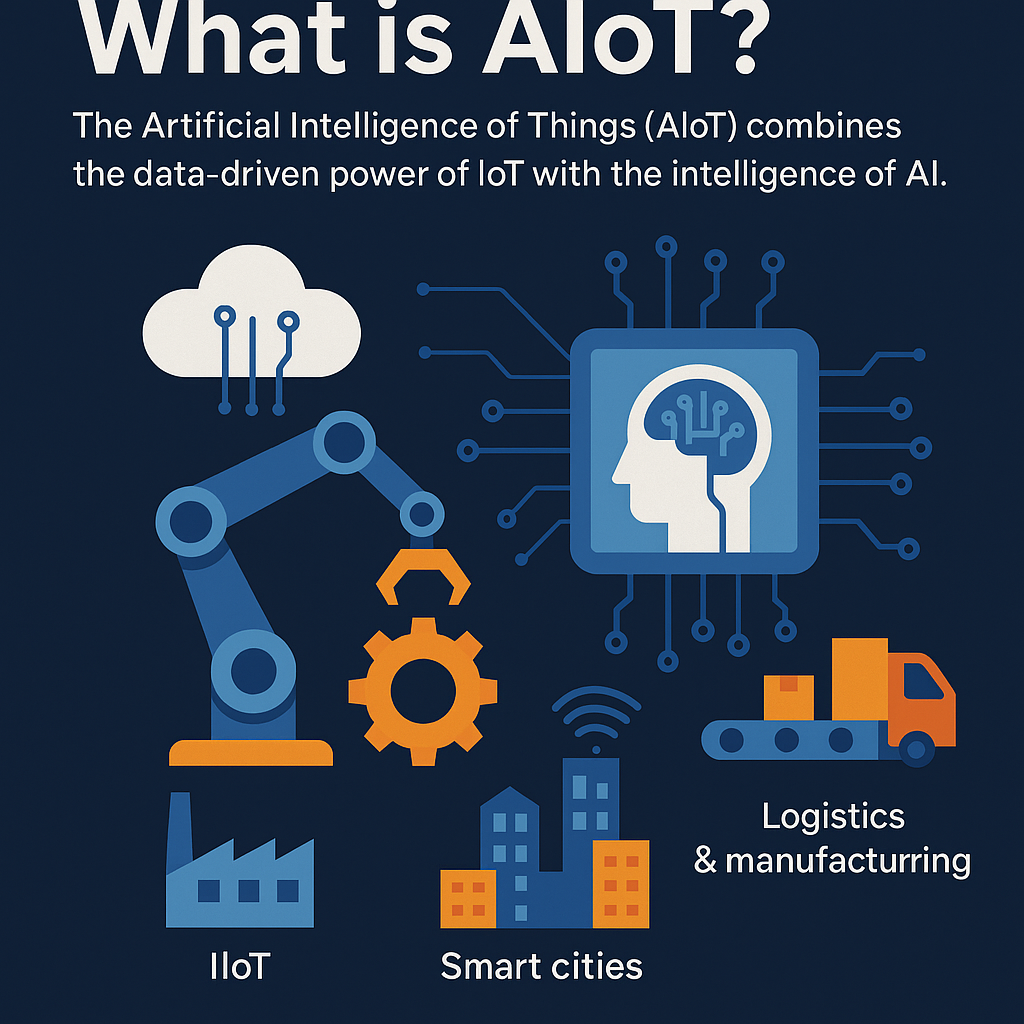
The Industrial Internet of Things (IIoT) is one of the most prominent AIoT use cases. In sectors like energy, utilities, and oil and gas, companies deploy smart sensors across equipment and infrastructure. Artificial Intelligence of Things, or AIoT, is the convergence of Artificial Intelligence (AI) and the Internet of Things (IoT). By combining the data-collecting capabilities of IoT with the decision-making power of AI, AIoT enables smarter, faster, and more autonomous systems. This fusion unlocks value across industries—allowing devices not just to sense the environment, but to understand it, learn from it, and act intelligently in real time.
AIoT vs. IoT and AI Alone
- IoT refers to a network of physical devices—sensors, machines, wearables, etc.—that collect and exchange data.
- AI includes machine learning, deep learning, and other techniques that enable machines to perform tasks requiring intelligence.
- AIoT combines both: AI brings intelligence to IoT data streams, enabling devices and systems to make decisions without human intervention.
This combination transforms passive data collection into actionable insight and automated response.
Key Benefits of AIoT
- Real-Time Decision Making: AI models can analyze streaming data and trigger immediate actions.
- Predictive Maintenance: AI can identify patterns in sensor data that signal failure before it happens.
- Autonomous Operations: AI-enabled devices can act without human input, reducing errors and improving efficiency.
- Scalability: AIoT systems adapt and learn, making them more efficient over time.
Industrial Internet of Things (IIoT)
The Industrial Internet of Things (IIoT) is one of the most prominent AIoT use cases. In sectors like energy, utilities, and oil and gas, companies deploy smart sensors across equipment and infrastructure.
AIoT in IIoT includes:
- Monitoring vibration, heat, and usage patterns in factory machinery to predict failures
- Automatically adjusting system performance in real time
- Enhancing worker safety through intelligent wearables and surveillance
These systems drastically reduce downtime, maintenance costs, and human error.
Smart Cities
AIoT plays a foundational role in developing smart cities by powering intelligent infrastructure.
Examples include:
- Traffic Management: AIoT can monitor traffic in real time and optimize signal timing.
- Energy Grids: Smart grids use AIoT to manage loads, reduce outages, and integrate renewables.
- Waste Management: AIoT systems track fill levels in bins and plan efficient collection routes.
- Public Safety: AI-enabled surveillance systems detect anomalies like crowd surges or unattended bags.
By streamlining city services, AIoT improves sustainability and citizen experience.
Logistics and Supply Chain
Logistics firms benefit from AIoT through real-time visibility, automation, and optimization across the supply chain.
Use cases include:
- Fleet Monitoring: AIoT tracks vehicle health and predicts maintenance needs.
- Asset Tracking: Sensors and AI detect anomalies in shipment conditions (e.g., temperature breaches for perishables).
- Warehouse Automation: Robots use AIoT to move inventory, avoid obstacles, and adapt routes dynamically.
- Demand Forecasting: AI analyzes purchase patterns to predict inventory needs and reduce overstocking.
Together, these applications reduce delays, losses, and operating costs.
Manufacturing
In smart factories, AIoT systems are used to boost production efficiency, quality control, and worker safety.
Key applications include:
- Quality Inspection: AI-powered cameras detect microscopic defects in products.
- Process Optimization: Real-time data from IoT devices feeds into AI models to fine-tune manufacturing processes.
- Worker Assistance: Wearable devices provide safety alerts or guide complex tasks using AR/AI overlays.
- Energy Optimization: AIoT helps manage energy usage based on real-time load demands.
Manufacturers deploying AIoT can dramatically increase output while reducing waste and defects.
AIoT Architecture
AIoT architectures typically include:
- IoT Devices: Sensors, cameras, actuators, and edge devices
- Edge Processing: AI models deployed locally for low-latency decision making
- Cloud Intelligence: Centralized AI systems for model training and cross-device coordination
- Data Management: Systems to ensure secure, scalable, and compliant data storage and sharing
- User Interfaces: Dashboards or mobile apps to visualize insights and alerts
Edge computing is especially crucial in AIoT to reduce latency and improve response times for critical applications.
Challenges to Consider
While AIoT offers significant advantages, implementation comes with challenges:
- Data Security: More endpoints mean a larger attack surface for cyber threats.
- Interoperability: Devices from different vendors must work together.
- AI Model Training: Requires large datasets and computational power.
- Cost: Initial deployment of AIoT systems can be expensive.
- Skills Gap: Implementing and managing AIoT demands expertise in both fields.
Businesses must assess these factors carefully and invest in scalable, secure AIoT frameworks.
The Future of AIoT
AIoT is evolving rapidly with the help of advances in generative AI, 5G, and edge computing. As networks become faster and more devices come online, AIoT systems will enable entirely new experiences, from self-healing factories to autonomous retail stores and intelligent public infrastructure.
Governments and enterprises are already investing heavily in AIoT to gain operational advantages and meet sustainability goals. Whether in smart cities, industrial automation, or digital healthcare, AIoT is not just enhancing operations—it is shaping the next frontier of connected intelligence.
Learn more at AIoT World Expo, Feb 10-12, 2026.
Aside from his role as CEO of TMC and chairman of ITEXPO #TECHSUPERSHOW Feb 10-12, 2026, Rich Tehrani is CEO of RT Advisors and a Registered Representative (investment banker) with and offering securities through Four Points Capital Partners LLC (Four Points) (Member FINRA/SIPC). He handles capital/debt raises as well as M&A. RT Advisors is not owned by Four Points.
The above is not an endorsement or recommendation to buy/sell any security or sector mentioned. No companies mentioned above are current or past clients of RT Advisors.
The views and opinions expressed above are those of the participants. While believed to be reliable, the information has not been independently verified for accuracy. Any broad, general statements made herein are provided for context only and should not be construed as exhaustive or universally applicable.