Key Takeaways:
• Microsoft introduced a lightweight AI model, “Mu,” that powers a new Settings agent in Windows 11
• The 330M-parameter model runs fully offline on Copilot+ PCs, delivering sub-500 millisecond response times
• Mu uses an encoder–decoder architecture to efficiently map natural language queries to system actions
Windows 11’s New Settings Agent Runs on Microsoft’s Custom On-Device AI Model “Mu”
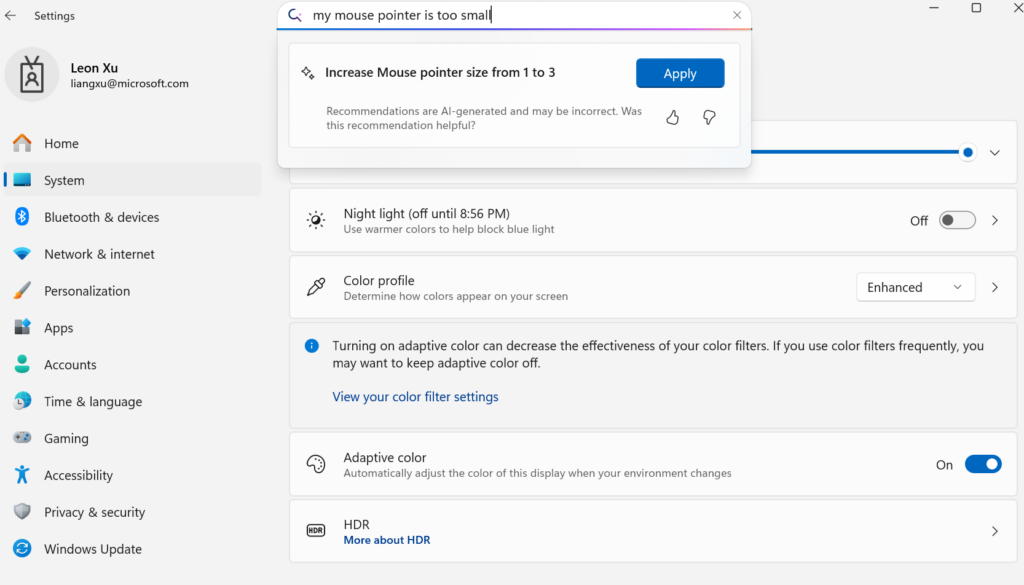
Microsoft has introduced a new AI-powered Settings agent in Windows 11 that runs locally using a purpose-built small language model called “Mu.” Part of the company’s broader push into local, privacy-preserving AI, Mu is optimized for speed and utility on Copilot+ PCs and enables users to control system settings through natural language—without any cloud connectivity.
The Settings agent is one of the first fully local, AI-driven features embedded into the Windows operating system. It’s designed to respond to user queries like “turn off Bluetooth” or “dim my display” and carry out those commands directly within the Settings menu, streamlining what would otherwise require multiple clicks or buried menu navigation.
This is great news as it makes the OS better as you don’t need to be an expert to fine-tune it. In addition, it allows for people purchasing these computers to actually get something useful out of them – besides better battery life and lighter weight.
What Makes Mu Different
Mu is a 330-million parameter language model developed specifically for inference on-device. Despite being much smaller than traditional large language models, it delivers performance comparable to models ten times its size. According to Microsoft engineers, this efficiency is achieved through a custom encoder–decoder architecture that separately handles input processing and output generation.
This architecture allows Mu to run entirely on the Neural Processing Unit (NPU) of Copilot+ PCs, which are purpose-built to support generative AI workloads. It processes over 100 tokens per second and responds in under 500 milliseconds—providing the real-time responsiveness needed for user-facing tasks like system control.
From Nested Menus to Natural Commands
By integrating Mu into the Settings experience, Microsoft is redefining how users interact with the OS. Instead of manually navigating through multiple levels of settings, users can now simply type or speak what they want. Whether it’s enabling airplane mode or adjusting accessibility features, the Settings agent interprets the request and delivers the desired outcome directly.
Crucially, this functionality does not rely on an internet connection or Microsoft’s cloud infrastructure. Mu runs entirely on the local device, preserving privacy and ensuring a consistent experience even in offline environments. This also addresses latency and compliance challenges associated with cloud-dependent AI.
Part of a Larger AI Push in Windows
The debut of Mu is the latest move in Microsoft’s strategy to embed AI natively across Windows. Alongside Mu, Microsoft has been developing tools like Windows ML 2.0 and the Windows AI Foundry Runtime, which allow applications and services to harness on-device AI with improved efficiency.
The Settings agent serves as a working proof-of-concept for how these local models can support agentic AI use cases—autonomous, task-specific functions that work without human intervention. While early access is currently limited to Windows Insider builds for Copilot+ PCs, broader rollout plans are expected in future updates.
This initiative builds on Microsoft’s wider vision for AI integration across the operating system. The goal isn’t just conversational interfaces, but deeply embedded AI agents capable of making Windows more intuitive, accessible, and responsive to user intent—without compromising speed or data sovereignty.
Future Outlook
Looking forward, Microsoft aims to refine and expand Mu’s capabilities. Potential applications may include extending the model to additional areas of the OS, supporting more complex multi-step actions, or even personalizing interactions based on individual usage patterns. Because Mu operates offline and at low computational cost, it opens the door for scalable AI features on a wide range of devices—not just high-end systems.
This marks a shift away from AI as a cloud-bound assistant and toward AI as a core component of the desktop experience. By building specialized, low-latency models like Mu into the operating system, Microsoft is laying the groundwork for a more agent-driven user interface—one where interacting with your device becomes more about intent than navigation.
Learn how AI Agents can supercharge your company’s profits and productivity at TMC’s AI Agent Event in Sept 29-30, 2025 in DC.
Rich Tehrani serves as CEO of TMC and chairman of ITEXPO #TECHSUPERSHOW Feb 10-12, 2026 and is CEO of RT Advisors and is a Registered Representative (investment banker) with and offering securities through Four Points Capital Partners LLC (Four Points) (Member FINRA/SIPC). He handles capital/debt raises as well as M&A. RT Advisors is not owned by Four Points.
The above is not an endorsement or recommendation to buy/sell any security or sector mentioned. No companies mentioned above are current or past clients of RT Advisors.
The views and opinions expressed above are those of the participants. While believed to be reliable, the information has not been independently verified for accuracy. Any broad, general statements made herein are provided for context only and should not be construed as exhaustive or universally applicable.
Portions of this article may have been developed with the assistance of artificial intelligence, which may have contributed to ideation, content generation, factual review, or editing.