Key Takeaways:
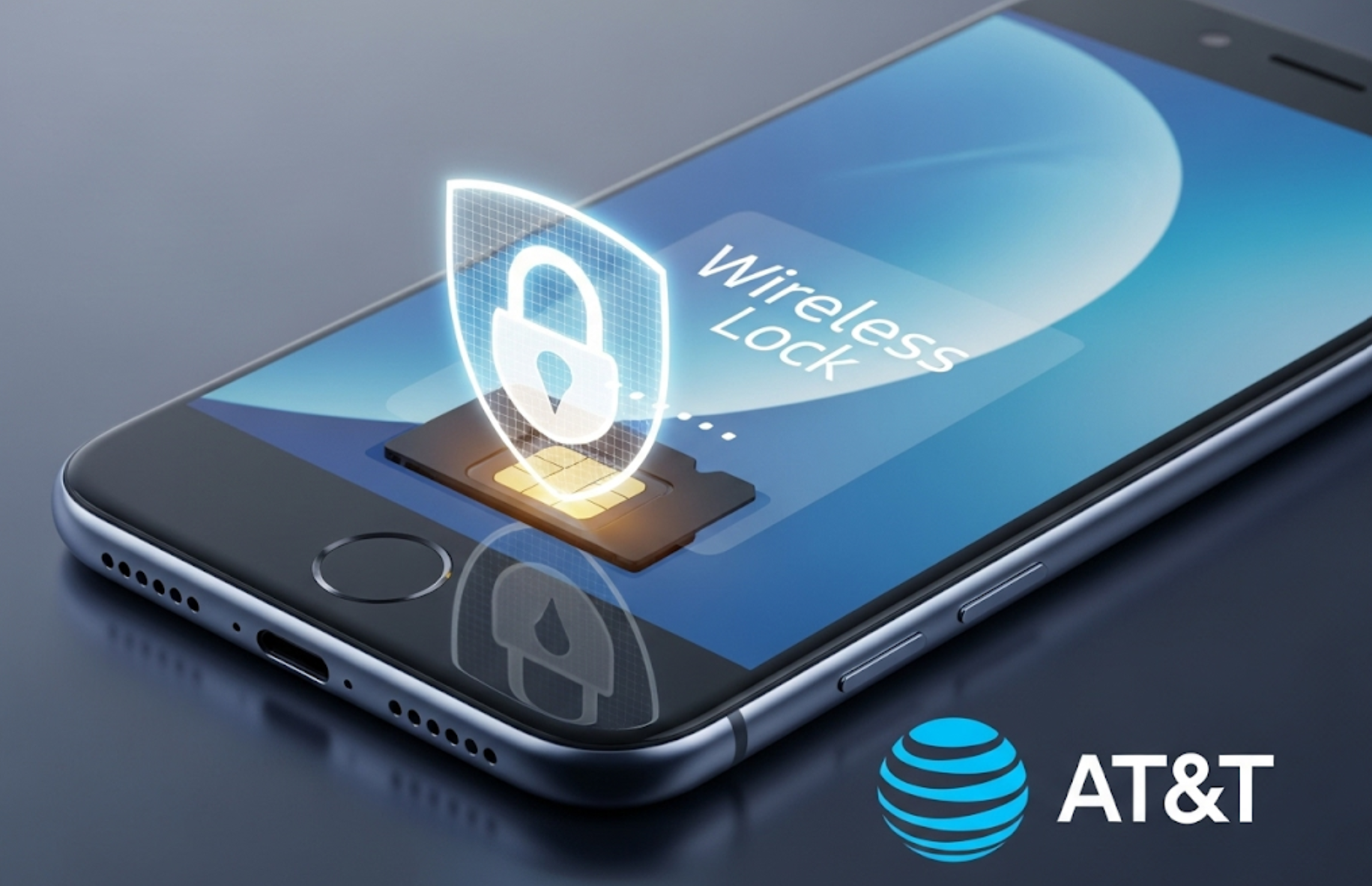
- AT&T has launched Wireless Lock, a new account security feature aimed at stopping SIM-swap attacks.
- The feature prevents unauthorized changes like SIM swaps, number transfers, and device swaps.
- Customers can activate and deactivate the lock through the myAT&T app.
- Similar protections are already offered by Verizon and T-Mobile.
- The move reflects rising industry concern over the financial and security risks tied to SIM-swap fraud.

AT&T is rolling out a new defense mechanism called Wireless Lock, designed to protect customers from SIM-swap attacks—a growing form of fraud that allows criminals to hijack phone numbers and gain access to sensitive accounts.
Once Wireless Lock is enabled through the myAT&T app, AT&T will block changes to 12 types of account settings, including SIM card swaps, device changes, number transfers, port-outs, and certain billing modifications. The feature helps prevent attackers from impersonating a customer to take over their phone number.
“With Wireless Lock enabled, you’re in control,” the company said in its announcement. “Your line can’t be moved to another device or carrier without your say-so.”
SIM-swap attacks have become increasingly common as threat actors target phone-based two-factor authentication to gain entry to bank accounts, crypto wallets, and social media profiles. The Federal Communications Commission and FBI have both flagged SIM-swapping as a rising threat. Criminals typically gather personal data about a victim—through phishing or data leaks—and use it to convince a wireless provider to issue a new SIM card tied to the victim’s number.
In response, wireless carriers are starting to take more visible steps. Verizon offers a Number Lock feature, and T-Mobile has tools such as account PINs and port-out protection. AT&T’s Wireless Lock now joins these safeguards, giving customers greater control over how and when their account information can be changed.
To use Wireless Lock, customers need to download or open the myAT&T mobile app. The feature can be turned on or off manually, and reauthentication is required to make changes. If a customer legitimately wants to switch phones or carriers, they’ll need to disable the lock temporarily within the app.
Security experts recommend combining carrier protections like Wireless Lock with additional steps, such as strong passwords, app-based authentication tools, and awareness of phishing tactics.
While the new feature introduces some extra friction for legitimate changes, it may help significantly reduce the chances of unauthorized SIM transfers—particularly for individuals at higher risk, such as those managing financial or business accounts.
The launch signals how mobile carriers are evolving their security posture as fraud techniques grow more sophisticated. For AT&T customers, Wireless Lock offers an added layer of defense that could deter or at least slow down malicious actors trying to exploit mobile infrastructure for gain.
Learn how AI Agents can supercharge your company’s profits and productivity at TMC’s AI Agent Event, Sept 29-30, 2025 in DC.

If you liked this post, you’ll love one of the the leading global business communications and technology events since 1999, the ITEXPO #TECHSUPERSHOW, Feb 10-12, 2026 Fort Lauderdale, Florida.
Don’t forget the collocated MSP Expo – just for managed service providers!
Aside from his role as CEO of TMC and chairman of ITEXPO #TECHSUPERSHOW Feb 10-12, 2026, Rich Tehrani is CEO of RT Advisors and a Registered Representative (investment banker) with and offering securities through Four Points Capital Partners LLC (Four Points) (Member FINRA/SIPC). He handles capital/debt raises as well as M&A. RT Advisors is not owned by Four Points.
The above is not an endorsement or recommendation to buy/sell any security or sector mentioned. No companies mentioned above are current or past clients of RT Advisors.
The views and opinions expressed above are those of the participants. While believed to be reliable, the information has not been independently verified for accuracy. Any broad, general statements made herein are provided for context only and should not be construed as exhaustive or universally applicable.
Portions of this article may have been developed with the assistance of artificial intelligence, which may have contributed to ideation, content generation, factual review, or editing