
Key Takeaways:
- AI is changing the malware problem from a detection issue into a scale issue.
- Varist says its Hybrid Detection Engine is designed to scan files deeply and quickly, including unknown threats, without relying on traditional sandbox detonation.
- MSPs and MSSPs may see an opportunity to use stronger file analysis as both a security differentiator and a margin improvement tool.
- Healthcare, email security, secure file transfer, and OEM security platforms are emerging as practical use cases.
The cybersecurity industry has spent years telling businesses that malware is getting more sophisticated. That is true, but it may no longer be the most important part of the story. The bigger issue now is volume, speed, and variation. AI gives attackers a way to generate, modify, and test malicious content faster than traditional security workflows were designed to handle.
That creates a basic problem for MSPs. They are being asked to help clients move faster with AI while also protecting them from threats that may be created, altered, and delivered at machine speed. It is not just another security product conversation. It is becoming an operations conversation, a margin conversation, and in some verticals, a compliance conversation.

That is the opening Varist is trying to address.
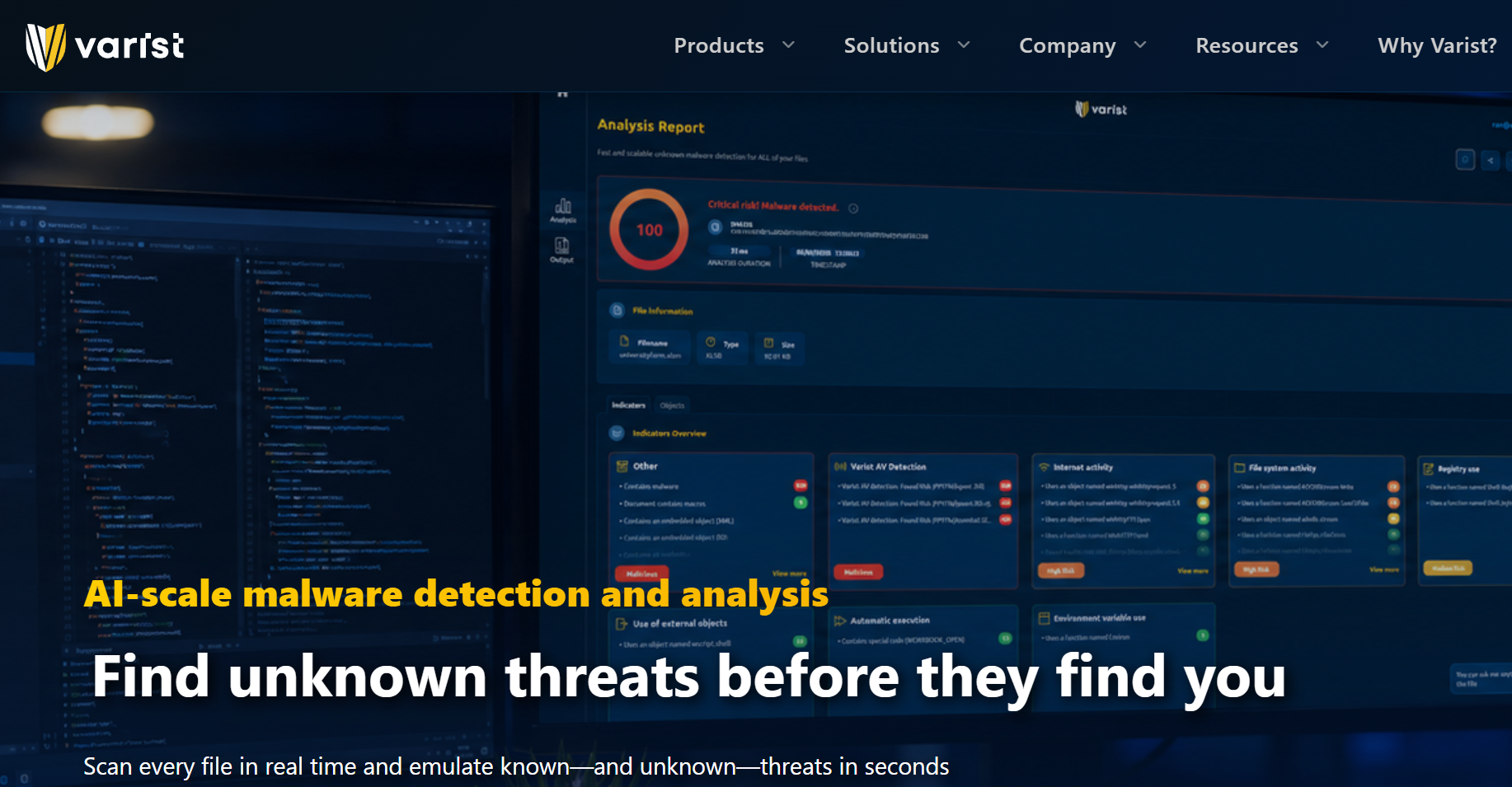
In a video briefing today, Siggi Petursson, CPO at Varist and formerly SVP of Engineering at SentinelOne, described the company’s focus as “file scanning at scale,” an area he said represented a gap he saw before joining Varist. The company’s core pitch is not simply that it detects malware. It is that it can deeply analyze files before execution and surface behavioral metadata about what a file may do, including suspicious code injection, URLs embedded inside files, network activity, and other behaviors that may warrant further review.
That distinction matters. Traditional approaches often depend on known signatures, heuristics, sandbox detonation, or endpoint activity after something begins to execute. Those methods still have a place. But in an AI driven threat environment, the timing and cost tradeoffs can get uncomfortable. If every suspicious file needs to be routed to a sandbox, response time and operational cost can rise quickly.
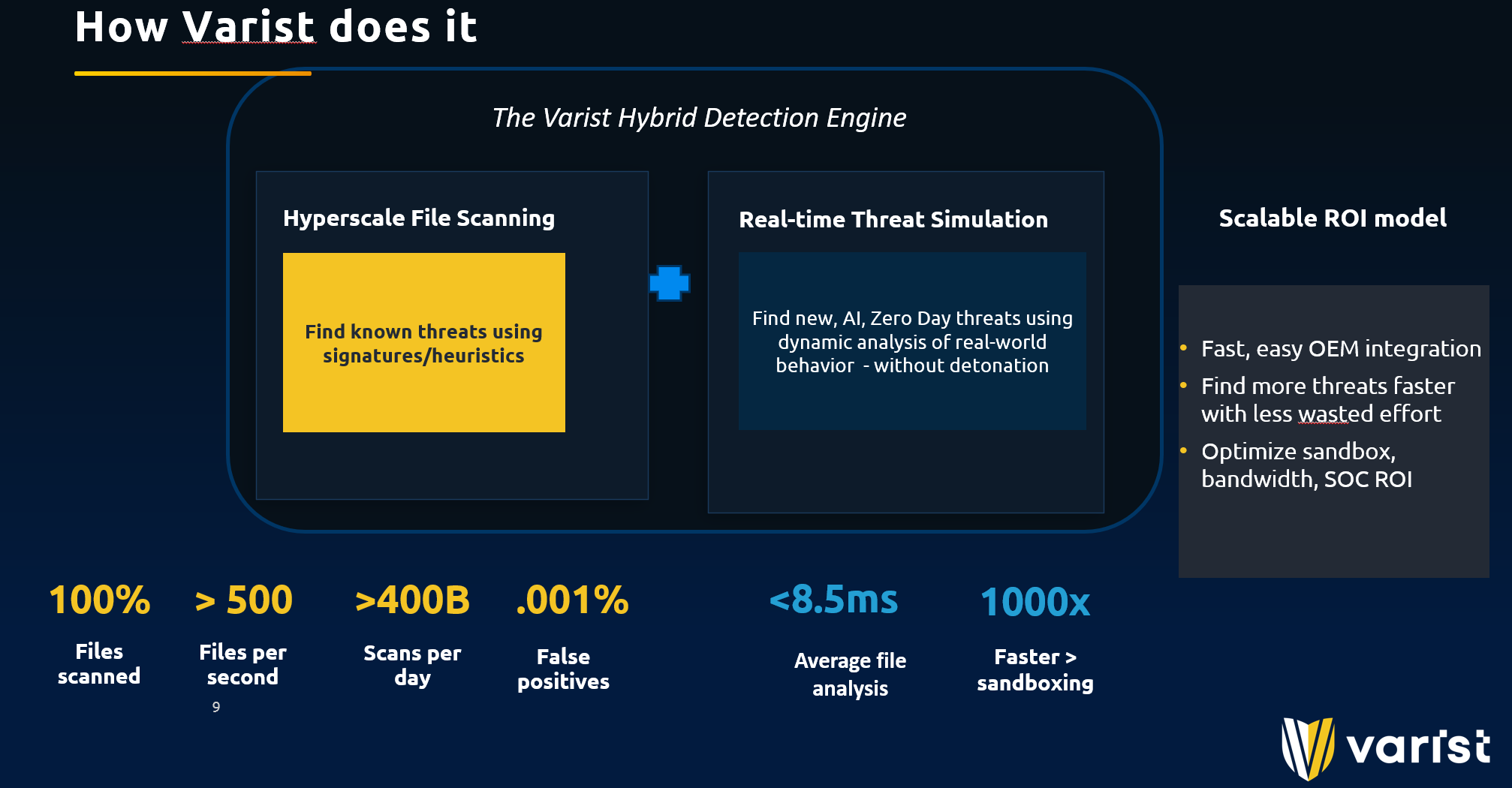
Varist’s answer is its Hybrid Detection Engine, which the company says is built to detect both known and zero day threats at scale. Help Net Security reported that the engine is built on technology used to perform more than 500 billion file scans per day for global customers, with each instance processing approximately 500 files per second, suspicious file analysis in under nine milliseconds, and false positives below 0.001 percent.
The company’s MSP value proposition deck frames the issue plainly: conventional malware detection cannot keep up with AI. The deck argues that AI scale detection needs four capabilities, finding known threats at scale, finding unknown threats in real time, identifying the presence or use of AI, and integrating cost effectively. It also positions Varist as an OEM focused company trusted by hyperscalers, MSPs, cloud providers, and cybersecurity vendors.
There is a practical reason this could resonate with MSPs. Many small and midsized businesses do not want another abstract security discussion. They want to know whether the files entering their organization are safe enough to open, store, route, and share. That is especially true in industries where files are central to daily operations.
Healthcare is one example Varist emphasized in the briefing. Petursson pointed to the risk around PDFs, office files, and DICOM medical imaging files. PDFs are a good example of the mismatch between user perception and technical reality. Many users think of a PDF as a static piece of paper. In practice, PDFs can include scripts and other active content. Petursson described this as a major reason the format remains risky, especially when users treat it as inherently safe.
That same logic applies to email, secure file transfer, content repositories, and other file heavy workflows. If an MSP can add deeper analysis without forcing customers into a rip and replace project, the service becomes easier to package. The Varist deck specifically points to fast OEM integration, improved service margin, and the ability to optimize sandbox, bandwidth, cloud, and SOC investments.
Recent public moves support the broader strategy. In March 2026, Varist launched the Varist Community, a free platform that lets users upload suspicious files for real time analysis and maliciousness ratings. Business Wire noted that the community provides granular analysis and risk ratings within seconds, using predictive behavioral analytics to simulate how file elements may behave in real world environments without executing malware like traditional sandboxes.
That free community angle is important for MSPs because it creates a simple entry point into a more sophisticated security discussion. Instead of starting with fear based messaging, an MSP can start with a file. Is this attachment safe? Why is it suspicious? What behaviors are inside it? Those are easier conversations to have with SMB clients than abstract warnings about AI generated malware.
Varist also recently announced a strategic alliance with NetSTAR, combining NetSTAR’s URL, IP, web application, and reputation intelligence with Varist’s packet and file based malware detection. The companies said the collaboration is designed to improve detection of AI generated malware and provide more contextual threat intelligence to OEM partners, carriers, service providers, and security vendors.
Daniel Ashby, COO at NetSTAR, said, “The threat landscape is evolving at machine speed, particularly with generative AI enabling more sophisticated malware and phishing campaigns.” He added that aligning NetSTAR’s telemetry and categorization intelligence with Varist’s malware detection technology is intended to create a stronger intelligence ecosystem for partners. Finnbogi Finnbogason, CTO and Cofounder at Varist, said NetSTAR’s real time URL, IP, and web application intelligence complements Varist’s packet and file based behavioral detection capabilities.
This is where the MSP story gets more interesting. The threat landscape facing MSPs is not limited to malware attachments. ConnectWise’s 2026 MSP Threat Report said attackers are increasingly exploiting trusted identities, legitimate system tools, remote access infrastructure, and software supply chains to gain scalable access to MSP managed environments. That does not reduce the importance of file scanning. It actually increases the need for layered defenses, because malicious files may arrive through trusted channels, legitimate tools, or compromised vendor relationships.
Petursson’s briefing also highlighted a key architectural point. Varist is not trying to be the endpoint agent that does everything. Its model is largely OEM focused, embedding detection into service provider, email, cloud, MSSP, and cybersecurity vendor environments. That makes the company potentially relevant to MSPs in two ways. Some may encounter Varist through an existing platform. Others may look at Varist as a way to add deeper malware detection into a service bundle, especially for email security, healthcare workflows, secure file transfer, and regulated customer environments.
There are limitations to note. Encrypted files remain a challenge unless the customer or service provider has the key and chooses to decrypt before scanning. Petursson was direct on that point during the briefing, saying Varist cannot read the contents of a fully encrypted file without the key. Encoded or obfuscated content is different, and can be decoded or analyzed, but strong encryption still requires customer controlled access.
That caveat does not weaken the overall argument. It clarifies where the technology fits. Varist is addressing the large and growing class of files that can be scanned, analyzed, scored, and acted on before execution. In an MSP environment, that could help reduce unnecessary sandboxing, provide better triage, and give security teams a clearer view into why a file is risky.
A useful way to think about this is shift left for malware detection. The earlier a suspicious file can be analyzed, the less pressure falls on endpoint rollback, incident response, and customer recovery. That does not remove the need for EDR, identity security, backup, or user training. It gives MSPs another control point before malicious behavior spreads.
For MSPs, the business case may come down to packaging. A stronger malware analysis layer can be sold as part of a premium security bundle, used to support healthcare and critical infrastructure accounts, or positioned as a way to reduce operational drag inside the provider’s own workflow. Liza, speaking during the briefing, framed the MSP benefit as a dual value proposition: monetization on one side, and improved operations cost and margin on the other.
The timing is favorable. SMBs are more aware of ransomware, phishing, and AI enabled social engineering than they were even a few years ago. Many have either been hit, know someone who has been hit, or rely on vendors that have been affected. That creates a more receptive market for security bundles that are concrete, explainable, and tied to everyday behavior.
Varist’s message is not that AI makes every legacy security investment obsolete. A more reasonable reading is that AI changes the detection math. If attackers can create more variants, use better language, automate phishing, and potentially generate malware dynamically, then defenders need more scalable ways to inspect what enters the environment.
For MSPs, that may be the real takeaway. AI security is not just about helping customers adopt Copilot, ChatGPT, Claude, or private models safely. It is also about preparing for a world where attackers use the same automation curve. In that world, scanning some files, sandboxing a subset, and hoping known threat databases keep up may not be enough.
Varist is betting that file level behavioral analysis, delivered at hyperscale and embedded into existing platforms, becomes a necessary part of that next security stack. The company still has to prove how broadly MSPs will package and monetize it. But the problem it is pointing to feels very real: in an AI driven threat environment, speed and scale are no longer nice to have. They are becoming central to the security conversation.

If you liked this post, you’ll love one of the the leading global business communications and technology events since 1999, the ITEXPO #TECHSUPERSHOW, Feb 9-11, 2027 Fort Lauderdale, Florida.
Don’t forget the collocated MSP Expo – just for managed service providers!
Aside from his role as CEO of TMC and chairman of ITEXPO #TECHSUPERSHOW Feb 9-11, 2027, Rich Tehrani is CEO of RT Advisors and a Registered Representative (investment banker) with and offering securities through Four Points Capital Partners LLC (Four Points) (Member FINRA/SIPC). He handles capital/debt raises as well as M&A. RT Advisors is not owned by Four Points.
The above is not an endorsement or recommendation to buy/sell any security or sector mentioned. No companies mentioned above are current or past clients of RT Advisors.
The views and opinions expressed above are those of the participants. While believed to be reliable, the information has not been independently verified for accuracy. Any broad, general statements made herein are provided for context only and should not be construed as exhaustive or universally applicable.
Portions of this article may have been developed with the assistance of artificial intelligence, which may have contributed to ideation, content generation, factual review, or editing