AI is no longer just changing how companies create content. It is changing how buyers discover, evaluate, and compare companies.
The internet is becoming more automated. A recent TMCnet Insight article noted that AI agents are helping push automated traffic to levels that would have seemed aggressive even a year ago. Cloudflare data cited by Tom’s Hardware showed that bots now account for roughly 57.5% of HTTP requests, compared with 42.5% from humans. That does not mean humans have stopped using the web. It means more of the discovery, research, comparison, summarization, and decision support that used to happen through human browsing is now being influenced by AI systems.
That shift matters because buyers increasingly use AI tools to narrow their options before they ever contact a vendor. Adobe reported that traffic from AI sources to U.S. retail sites grew 393% year over year in the first quarter of 2026. In B2B technology marketing, 10Fold research cited by Demand Gen Report found that 52% of B2B tech marketers now rank AI-generated search and answer engines as their top content distribution channel. HubSpot’s 2026 marketing statistics also show that more than 92% of marketers plan on or are already optimizing for traditional and AI-powered search engines, while nearly 30% report decreased search traffic as consumers turn to AI tools.
This does not mean traditional SEO is dead. It does mean SEO is no longer enough by itself.
Companies now need to think about AI visibility as a measurable business function. That includes content, technical SEO, media presence, third-party validation, social activity, community participation, reviews, competitive tracking, and category-specific authority.
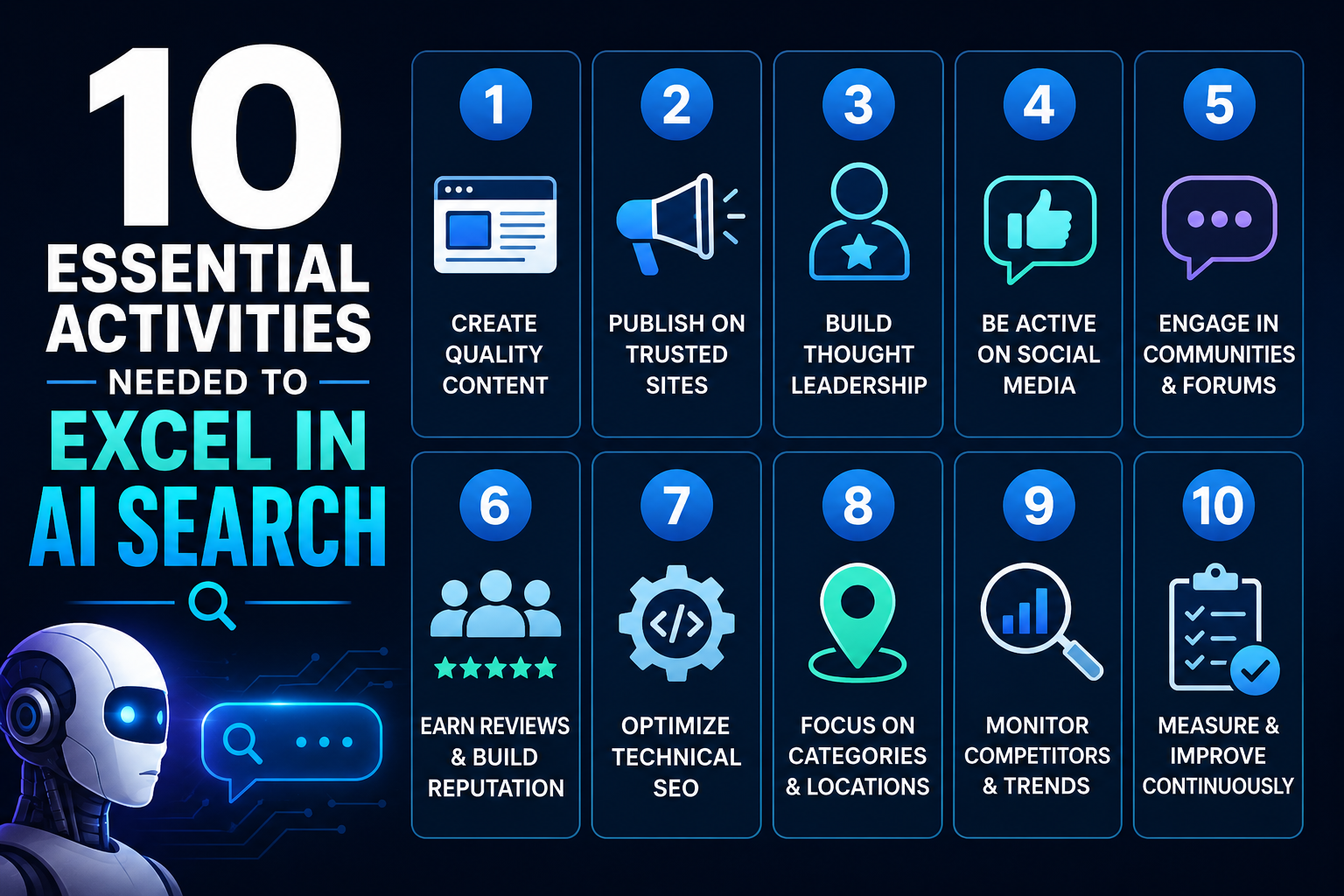
Here are 10 things companies need to do to improve their chances of being discovered in AI search.
1. Understand that AI search is becoming a new discovery layer
AI search is not just another traffic source. It is becoming a new layer between buyers and companies.
A buyer may no longer search for “managed IT provider near me” and click through 10 results. They may ask an AI assistant to compare providers, explain which companies are credible, identify vendors in a specific industry, or summarize the strongest options in a particular region.
That means companies have to be visible in the sources AI systems rely on to generate answers. They also have to be described consistently across those sources. If AI systems cannot clearly understand what a company does, what categories it serves, where it operates, and how it compares to alternatives, the company may be left out of the answer.
The rise of bot-driven traffic reinforces the point. As more web activity is handled by bots, crawlers, and AI agents, companies need to make sure their digital presence is built for machine interpretation as well as human reading.
2. Define every category where you need to be found
Many companies talk about AI visibility too broadly. That is a mistake.
A company does not simply need to “rank in AI.” It needs visibility in the categories that matter to its business.
For example, a managed services provider may need to appear for managed IT services, cybersecurity, cloud migration, help desk support, Microsoft 365 management, compliance support, and healthcare IT. A communications company may need to appear for UCaaS, contact center, cloud communications, SIP trunking, Microsoft Teams voice, and AI customer experience tools.
Each category should be tracked separately. AI systems may recognize a company in one category but ignore it in another. A company may be visible for “tech support” but not “24/7 help desk support.” It may appear for “smart home installation” but not “computer repair.” These differences matter because buyers ask category-specific questions.
Companies should build a clear category map, then create content and proof points for each category.
3. Factor in geography when location matters
For many businesses, AI visibility is not just category-specific. It is also location-specific.
A company may serve a national market, a regional market, or specific metro areas. AI results can change when the query includes a location. “Top cybersecurity companies” may produce one set of answers. “Top cybersecurity companies in Connecticut” may produce another. “Managed IT providers for financial services in New York” may produce another still.
This means companies should measure AI visibility by category and location where appropriate.
Location-specific service pages, local case studies, regional media mentions, local reviews, and structured data can all help reinforce where a company operates. This is especially important for MSPs, consultants, field service firms, healthcare IT companies, home services providers, and businesses with regional sales coverage.
4. Produce quality content on your own site
Owned content remains one of the most important foundations of AI search visibility.
Your website should clearly explain what your company does, who it serves, what problems it solves, and how each service works. This content should not be thin or generic. AI systems need depth, clarity, and consistency.
Useful owned content can include service pages, buyer guides, comparison guides, FAQ pages, implementation guides, industry-specific landing pages, customer stories, executive blogs, technical explainers, and educational articles.
The goal is not to stuff pages with keywords. The goal is to make the company easier to understand, categorize, and cite.
If a company wants to be known for cybersecurity, AI agents, managed services, compliance, cloud communications, or any other category, its website should contain meaningful content that supports that position.
5. Publish on credible third-party media sites
Owned content is necessary, but it is not enough.
AI systems also look across the broader web for validation. Articles on respected media sites, contributed thought leadership, interviews, event coverage, podcast appearances, analyst mentions, and industry publications can all help establish that a company is part of the market conversation.
This is where quality matters. A thoughtful article on a relevant industry site can be more useful than a large number of low-quality posts. AI systems are more likely to benefit from clear, authoritative, well-structured content that explains a company’s expertise in context.
Third-party content also helps address a trust issue. A company saying something about itself is useful. Other credible sites discussing the company, quoting its executives, or placing its expertise in a broader market context can be more persuasive.
6. Build executive and company thought leadership
AI search visibility is not only about the company brand. It is also about the people behind the company.
Executives, founders, technical leaders, product leaders, and subject matter experts should be visible around the categories the company wants to own. Their names, quotes, articles, interviews, LinkedIn posts, conference sessions, and media commentary all help establish expertise.
This matters because AI systems often look for patterns of authority. A company with leaders who consistently explain market trends, respond to industry developments, and offer practical guidance may have more visible expertise than a company that only publishes product pages.
Thought leadership should be substantive. It should help buyers understand a problem, evaluate options, or respond to a market change. It should not read like a sales pitch.
7. Use social media to reinforce the same category signals
Social media is part of AI visibility because it helps reinforce what a company talks about, how often it participates in the market, and whether its executives have a clear point of view.
LinkedIn is especially important for B2B companies. YouTube can also matter, particularly for educational videos, demos, webinars, and product explainers. Short-form clips, customer stories, executive commentary, and practical how-to content can all support the company’s category positioning.
The key is consistency. If the website says the company is a cybersecurity leader but the company’s social presence rarely discusses cybersecurity, the signal is weaker. If the company wants to be known for AI agents, cloud communications, or managed IT, those themes should appear regularly across social channels.
8. Pay attention to Reddit, forums, and community discussions
Reddit and forums can shape how AI systems understand market sentiment.
Many companies ignore these channels because they are difficult to control. That is exactly why they can matter. Buyers use forums to ask candid questions. Customers share experiences. Competitors are discussed. Technical users compare products. AI systems may draw on these discussions to understand what real people are saying.
Companies should not spam Reddit or forums. That can backfire quickly. Instead, they should monitor relevant discussions, answer questions where appropriate, correct misinformation carefully, and contribute useful expertise without turning every post into a pitch.
The goal is to become part of the knowledge ecosystem around the category.
9. Strengthen third-party reviews and directory presence
Review sites and third-party directories provide structured trust signals.
Depending on the category, this may include G2, Capterra, TrustRadius, Clutch, Gartner Peer Insights, Google Business Profile, industry directories, local service platforms, partner marketplaces, and vertical-specific review sites.
Companies should identify which platforms matter most in their market, build accurate profiles, and encourage satisfied customers to leave honest reviews. Reviews should be monitored and answered professionally.
This is not just about reputation management. It is also about discoverability. Third-party platforms often contain structured descriptions, categories, ratings, review language, comparisons, and customer proof points that AI systems can interpret.
10. Monitor competitors and track an AI search score over time
Companies need a way to measure progress.
That means monitoring how they perform in AI search by category, geography, and competitor set. They should know which companies appear when AI systems are asked about each category. They should track both the competitors they see every day and the companies that AI systems rank highest.
These may not always be the same.
A company may think its main competitor is a familiar local rival, while AI systems consistently mention a national provider, a software platform, a marketplace, or a lesser-known company with stronger content signals.
A useful AI visibility process should answer several questions:
Which categories do we appear in?
Which categories are we missing?
Which competitors rank ahead of us?
What content do those competitors have that we do not?
Are they stronger in media coverage, reviews, Reddit, social, technical SEO, or thought leadership?
What content should we create next?
Which executives need to be more visible?
Which customer reviews or proof points are missing?
What technical SEO issues are limiting machine readability?
A FusionScore.ai audit offers one example of how this type of measurement can work. In one audit, visibility was scored by category, competitors were tracked, gaps were identified across Reddit, social media, technical SEO, structured data, and review platforms, and a 12-month content calendar was generated to target weak categories by industry and location.
The broader point is that companies need a scorecard. Without one, AI visibility becomes guesswork.
The New Reality: AI Visibility Requires Consistent Work
AI search is not a one-time project.
Companies need to produce quality content regularly. They need to compare themselves to competitors. They need to strengthen their owned site, third-party media presence, social channels, review profiles, community participation, and technical SEO. They need to update old content, create new content, monitor AI results, and keep improving.
For many companies, this could require two to three days per week of focused work.
That may sound like a lot, but the alternative is risky. If buyers increasingly rely on AI systems to create shortlists, compare vendors, and explain market options, companies that are not visible may never make it into the conversation.
Some companies will manage this internally. Others may use a platform such as FusionScore.ai to monitor AI search visibility, compare competitors, identify gaps, and build a regular content strategy. The platform should not replace strategy, expertise, or quality control, but it can help organize the work and make progress easier to track. For roughly the cost of a daily lunch, that may be more practical than trying to manually coordinate AI visibility across SEO, PR, content, social, reviews, and competitive research.
The internet is becoming more automated. Bots and AI agents are handling more of the discovery layer. Buyers are using AI to make sense of markets before they speak with sales.
That means companies need to be ready for a world where being findable by humans is no longer enough.
They also need to be findable, understandable, and credible to AI.
If you liked this post, you’ll love one of the the leading global business communications and technology events since 1999, the ITEXPO #TECHSUPERSHOW, Feb 9-11, 2027 Fort Lauderdale, Florida.
Rich Tehrani is founder of FusionsScore.ai and CEO of RT Advisors and a Registered Representative (investment banker) with and offering securities through Four Points Capital Partners LLC (Four Points) (Member FINRA/SIPC). He handles capital/debt raises as well as M&A. RT Advisors is not owned by Four Points.
The above is not an endorsement or recommendation to buy/sell any security or sector mentioned. No companies mentioned above are current or past clients of RT Advisors.
The views and opinions expressed above are those of the participants. While believed to be reliable, the information has not been independently verified for accuracy. Any broad, general statements made herein are provided for context only and should not be construed as exhaustive or universally applicable.
Portions of this article may have been developed with the assistance of artificial intelligence, which may have contributed to ideation, content generation, factual review, or editing