Key Takeaways:
• China has spent the past decade building a full-stack AI industrial policy—from chips and compute to data and open-source models
• Companies like Alibaba, DeepSeek, Huawei, and ByteDance are releasing high-performing open-source AI systems
• The government has funneled nearly $100 billion into semiconductors and committed $8.5 billion to AI startups in 2025
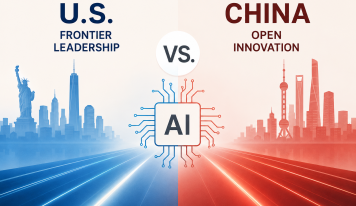
• While U.S. firms focus on proprietary models, China is leveraging open-source AI to scale influence and reduce reliance on foreign tech
• The approach has yielded results but still faces bottlenecks in chip manufacturing and shifting rapidly with emerging trends
After years of U.S. sanctions and export restrictions, Chinese companies are responding with speed and strategy. In 2024, OpenAI and other U.S. firms began limiting access to advanced AI services for Chinese users. Chinese developers responded by turning to Meta’s open-source offerings and quickly followed with their own.
Now, in mid-2025, China is rapidly narrowing the AI gap with the United States. Companies like Alibaba, DeepSeek, Huawei, and ByteDance are building and releasing competitive open-source large language models. Some rank among the top-performing systems in global benchmarks. But this success isn’t incidental—it reflects a decade-long industrial policy by the Chinese government.
According to Kyle Chan, an adjunct researcher at the RAND Corporation, “China is applying state support across the entire AI tech stack, from chips and data centers down to energy.” That support is helping local companies sidestep U.S. chip restrictions and continue advancing, even as Washington attempts to curtail their progress.

A Full-Stack, State-Led Strategy
China’s push to lead in AI mirrors the playbook it used to dominate solar panels, electric vehicles, and batteries. Over the past ten years, Beijing has invested heavily in high-tech manufacturing, providing grants, subsidies, and access to government-backed credit lines.
Key pillars of China’s AI policy include:
- Computing infrastructure: Government funding underwrites high-capacity data centers, semiconductors, and AI-optimized servers
- Human capital: Beijing has financed university labs and training centers to concentrate engineering talent, often in collaboration with tech giants like Alibaba and ByteDance
- Startup support: In April 2025, the government earmarked $8.5 billion for young AI companies, complementing a nearly $100 billion semiconductor fund launched in 2014
- Geographic clusters: Local governments have built neighborhoods like “Dream Town” in Hangzhou to serve as incubators for AI startups. These districts offer office space, housing, and subsidies to attract talent and investment
Jia Haojun, founder of Deep Principle—a Hangzhou-based AI startup focused on chemical research—said his company received $2.5 million in subsidies and substantial logistical support from the city. “For the government to help us cover even 10 or 15 percent of our early-stage research costs, that’s a huge benefit,” he noted.
Open Source as Strategic Leverage
Chinese companies have embraced open-source AI development in part because they can’t depend on continued access to U.S. closed models. Huawei, Baidu, and ByteDance have all released open-source models in recent months, with Alibaba and DeepSeek gaining global traction.
This approach not only supports local development but serves as a form of soft power. By making competitive models freely available, China is enabling developers around the world to build on its systems—potentially establishing Chinese models as global standards in emerging AI ecosystems.
“Open-source is a source of technological soft power,” said Kevin Xu, founder of Interconnected Capital. “It is effectively the Hollywood movie or the Big Mac of technology.”
ByteDance spent $11 billion last year on data centers and AI infrastructure to support such efforts. While U.S. companies like OpenAI and Google charge premium rates for API access, Chinese firms are giving away high-performing models that can be modified or fine-tuned freely.
This openness has earned the attention—and in some cases concern—of U.S. leaders. Sam Altman, CEO of OpenAI, warned that Chinese companies like DeepSeek could block American competitors from entering international markets. He has framed the issue as a contest between “democratic AI” and “authoritarian AI.”
A Double-Edged Policy
Despite the success stories, China’s AI industrial policy isn’t without flaws. The top-down nature of state-backed innovation means that resource allocation can be slow to adapt. Chinese companies spent years investing in facial recognition and surveillance AI, only to be caught off guard when generative AI—like ChatGPT—changed the game.
“A.I. is not like traditional industries like steel or shipbuilding, where the technology is fairly stable,” Chan from RAND explained. “It can be difficult to figure out where to invest and allocate resources.”
There are also hardware constraints. SMIC, China’s leading chip foundry, manufactures AI chips designed by Huawei. While these chips are reportedly good enough for many tasks, they still lag behind Nvidia’s in both performance and scale. Manufacturing yield and volume remain key bottlenecks.
To address this, the Chinese government has directed SMIC to produce alternatives such as chips tailored for Huawei’s Ascend platform. Although performance may trail, having a viable domestic fallback is viewed as a strategic priority in case of further tech decoupling.
Censorship and the AI Content Challenge
Another structural limitation is China’s tightly controlled internet. Many Chinese LLMs cannot be trained on sources like Reddit, Wikipedia, or YouTube—key inputs for Western models. Instead, the government has developed its own curated datasets like “the mainstream values corpus,” based on approved media sources.
This ensures compliance but may limit the richness and diversity of model output. However, the immense volume of domestic usage data from platforms like Douyin (TikTok’s Chinese twin) and WeChat allows Chinese firms to optimize for user engagement and behavior at scale.
ByteDance’s success with personalized content algorithms, for example, has translated well into AI assistant development. Even if data sources are filtered, user interaction data helps compensate by providing fine-tuning feedback loops.
Global Stakes
The global AI race is no longer just about building powerful models—it’s about shaping ecosystems. China’s emphasis on open-source and government-supported infrastructure could resonate with countries wary of paying U.S. cloud providers or subjecting their data to U.S. jurisdiction.
Meanwhile, U.S. firms are betting on closed systems and proprietary APIs, banking on superior performance and brand recognition. Whether openness or performance wins out will depend on use cases, developer preferences, and geopolitics.
As Chinese firms continue to narrow the gap, pressure is rising on U.S. policymakers to respond—not just with restrictions, but with domestic investment, open access initiatives, and international partnerships.
Learn how AI Agents can supercharge your company’s profits and productivity at TMC’s AI Agent Event in Sept 29-30, 2025 in DC.

Rich Tehrani serves as CEO of TMC and chairman of ITEXPO #TECHSUPERSHOW Feb 10-12, 2026 and is CEO of RT Advisors and is a Registered Representative (investment banker) with and offering securities through Four Points Capital Partners LLC (Four Points) (Member FINRA/SIPC). He handles capital/debt raises as well as M&A. RT Advisors is not owned by Four Points.
The above is not an endorsement or recommendation to buy/sell any security or sector mentioned. No companies mentioned above are current or past clients of RT Advisors.
The views and opinions expressed above are those of the participants. While believed to be reliable, the information has not been independently verified for accuracy. Any broad, general statements made herein are provided for context only and should not be construed as exhaustive or universally applicable.
Portions of this article may have been developed with the assistance of artificial intelligence, which may have contributed to ideation, content generation, factual review, or editing.