
Key Takeaways:
• Reflection, a new AI startup founded by former DeepMind and Google AI researchers, has introduced Asimov, a multi-agent AI system focused on software development
• Asimov processes code, documentation, team messages, and emails to understand full project context and assist more effectively than conventional code assistants
• The system uses reinforcement learning, similar to the AlphaGo model, to continuously improve based on developer feedback
• Asimov operates within private cloud environments to protect proprietary data and ensure enterprise-grade privacy
• Reflection plans to expand beyond coding into domains like sales and customer support while aiming for more generalizable AI capabilities
A new AI company led by some of Google’s former top researchers is making waves in the agentic AI space. Reflection, founded by alumni from DeepMind and other Google divisions, has launched Asimov, an intelligent AI agent designed to assist developers by understanding not only code, but also its broader context.
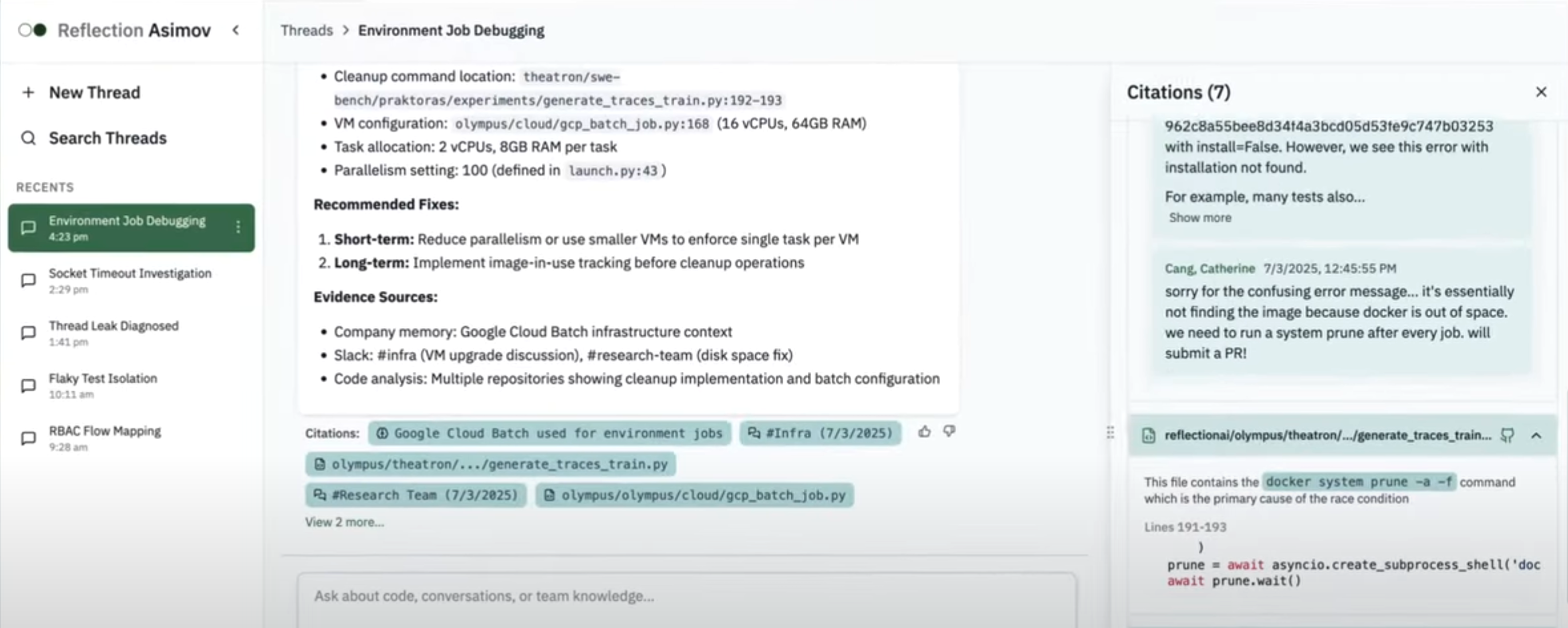
Unlike conventional AI coding assistants that focus on generating lines of code or suggesting snippets, Asimov is structured as a team of smaller agents. Each agent is responsible for different areas of understanding: analyzing codebases, reviewing team communication, parsing documentation, and processing project histories. This architecture enables Asimov to provide development suggestions rooted in the full scope of what a software team is building—not just what’s in the current file.
The system represents a philosophical shift in how AI can support complex work. Instead of acting like an autocomplete engine, Asimov tries to operate like a highly informed, context-aware collaborator—one that understands your team’s project history, requirements, and collaborative norms.
“Asimov is the best-in-class agent for codebase comprehension,” said Misha Laskin, Co-Founder & CEO of Reflection AI.
How Asimov Works
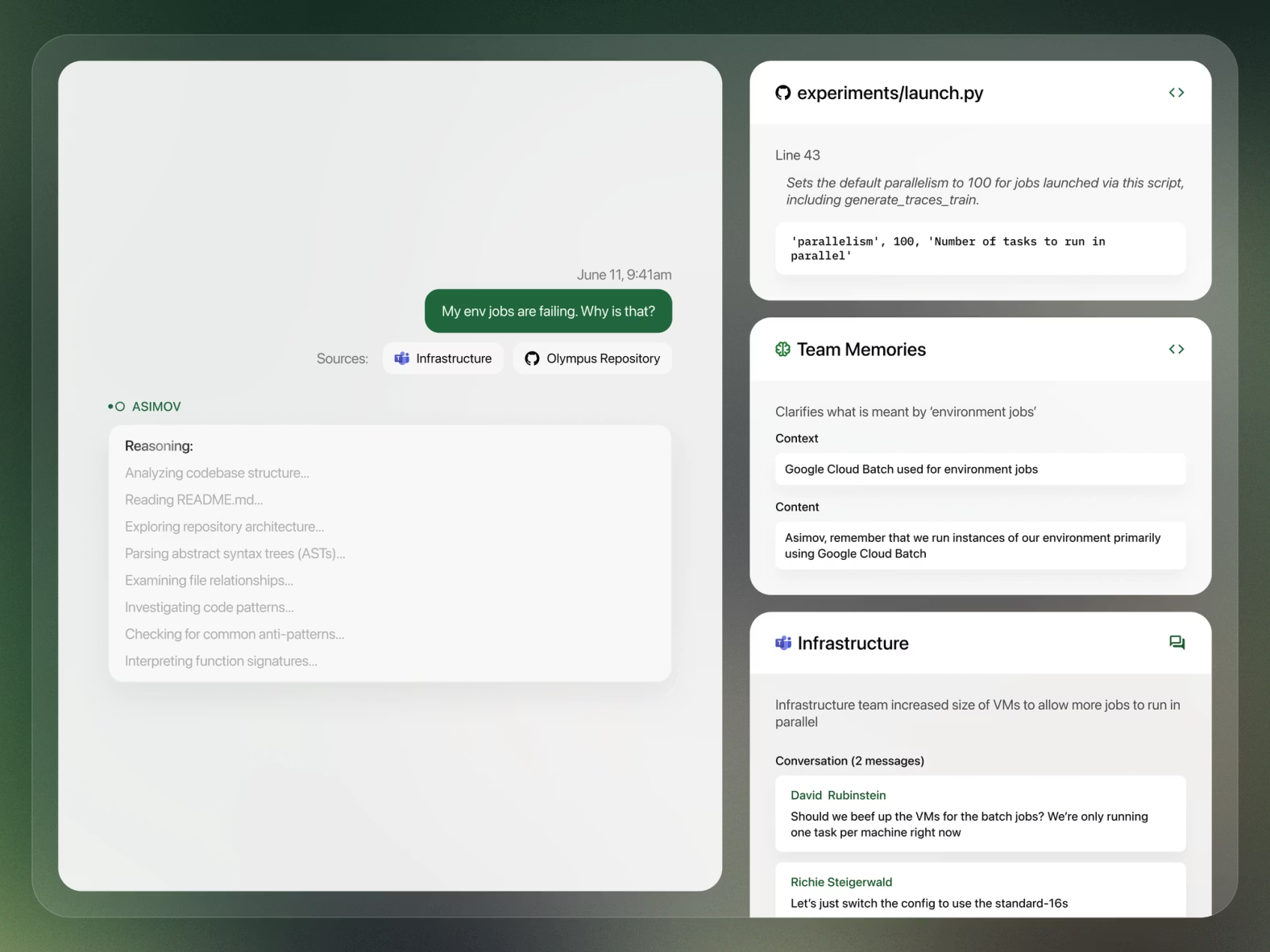
Asimov’s architecture is agentic in design. Rather than relying on one large language model to answer questions or complete tasks, the platform operates through a constellation of specialized agents that share knowledge and collaborate to form recommendations. Some analyze the project’s codebase and structure. Others monitor Slack conversations, email threads, and product specs. Together, they build a holistic understanding of what’s being built and why.
This allows the AI to offer suggestions that align not just with syntax but with architectural intent. For example, if a developer is working on a new feature that has been discussed in Slack and described in a product brief, Asimov pulls those threads together to recommend code that follows the intended business logic—not just general best practices.
This broader understanding helps the agent make fewer irrelevant suggestions and reduces the risk of conflicting implementation styles across a team. Asimov is designed to be embedded within a development team’s workflow and continuously adapt as the project evolves.
Reinforcement Learning from Human Feedback
The Asimov system is trained using reinforcement learning from human feedback (RLHF), an approach that gained prominence through projects like DeepMind’s AlphaGo. One of Reflection’s co-founders, Ioannis Antonoglou, was a key architect of that system.
Just as AlphaGo learned to improve its gameplay based on whether its moves resulted in wins, Asimov learns from how developers interact with its suggestions. If a recommendation is accepted, modified, or rejected, that signal is fed back into the system to help it improve. Over time, Asimov becomes more attuned to a team’s development style and preferences.
The feedback loop is not only technical but experiential. By observing which kinds of suggestions lead to more productive sessions, Reflection aims to tune Asimov toward usefulness, not just correctness.
Secure by Design
Asimov is built for enterprise environments and does not rely on public API calls or external cloud infrastructure. The system runs within private clouds, ensuring that proprietary source code, documentation, and communications remain secure. For enterprise customers concerned about data privacy and IP control, this is a key differentiator.
Reflection positions Asimov as a safer alternative to cloud-based code assistants like GitHub Copilot, which rely on shared infrastructure and limited visibility into how prompts and completions are logged or used. In contrast, Reflection offers transparency and control, allowing organizations to retain full ownership over their development data and models.
Early Testing and Developer Reception
In early testing, Reflection claims that developers preferred Asimov over tools like Claude Code. Feedback highlighted the system’s ability to offer suggestions that aligned more closely with project goals and team-specific logic. While traditional assistants focus heavily on syntax correctness, Asimov’s strength lies in understanding intent and business rules.
This contextual edge could prove crucial for larger teams or projects with long histories and complex documentation. Instead of needing to onboard a junior engineer or re-explain architectural decisions, teams can turn to Asimov as a persistent, up-to-date project memory.
Going Beyond Engineering
While Asimov’s initial application is software development, the team behind Reflection envisions broader uses. Sales and support are next on the roadmap, with agents designed to understand CRM systems, customer emails, and product FAQs. In those contexts, Asimov-style agents could prioritize leads, draft responses, or triage requests with deeper understanding of both customer intent and internal processes.
Reflection sees this not just as a product extension, but as a step toward generalizable AI agents. If AI systems can navigate complex, multistep tasks like software development or support ticket resolution—while learning from feedback—they may be capable of handling increasingly abstract knowledge work in the future.
The long-term vision is one in which AI agents are embedded across business functions, continually learning from humans and documents, and operating as trusted co-pilots.
Competition and Challenges
The competition in AI assistants is fierce. GitHub Copilot dominates the coding assistant space. OpenAI, Google, and Anthropic all offer multi-modal agents or model APIs that can be extended into development workflows. Startups like Cognition and Replit are also building intelligent development agents.
Reflection’s differentiation lies in its deep contextual embedding and privacy-first design. However, these come with costs: running the system requires significant compute, integration into multiple team systems, and onboarding time to understand project histories. Smaller teams or early-stage startups may find these barriers too high.
Reflection will also need to prove scalability and maintain quality as it expands to domains beyond software development.
Learn how AI Agents can supercharge your company’s profits and productivity at TMC’s AI Agent Event in Sept 29-30, 2025 in DC.

Rich Tehrani serves as CEO of TMC and chairman of ITEXPO #TECHSUPERSHOW Feb 10-12, 2026 and is CEO of RT Advisors and is a Registered Representative (investment banker) with and offering securities through Four Points Capital Partners LLC (Four Points) (Member FINRA/SIPC). He handles capital/debt raises as well as M&A. RT Advisors is not owned by Four Points.
The above is not an endorsement or recommendation to buy/sell any security or sector mentioned. No companies mentioned above are current or past clients of RT Advisors.
The views and opinions expressed above are those of the participants. While believed to be reliable, the information has not been independently verified for accuracy. Any broad, general statements made herein are provided for context only and should not be construed as exhaustive or universally applicable.
Portions of this article may have been developed with the assistance of artificial intelligence, which may have contributed to ideation, content generation, factual review, or editing.