
Key Takeaways
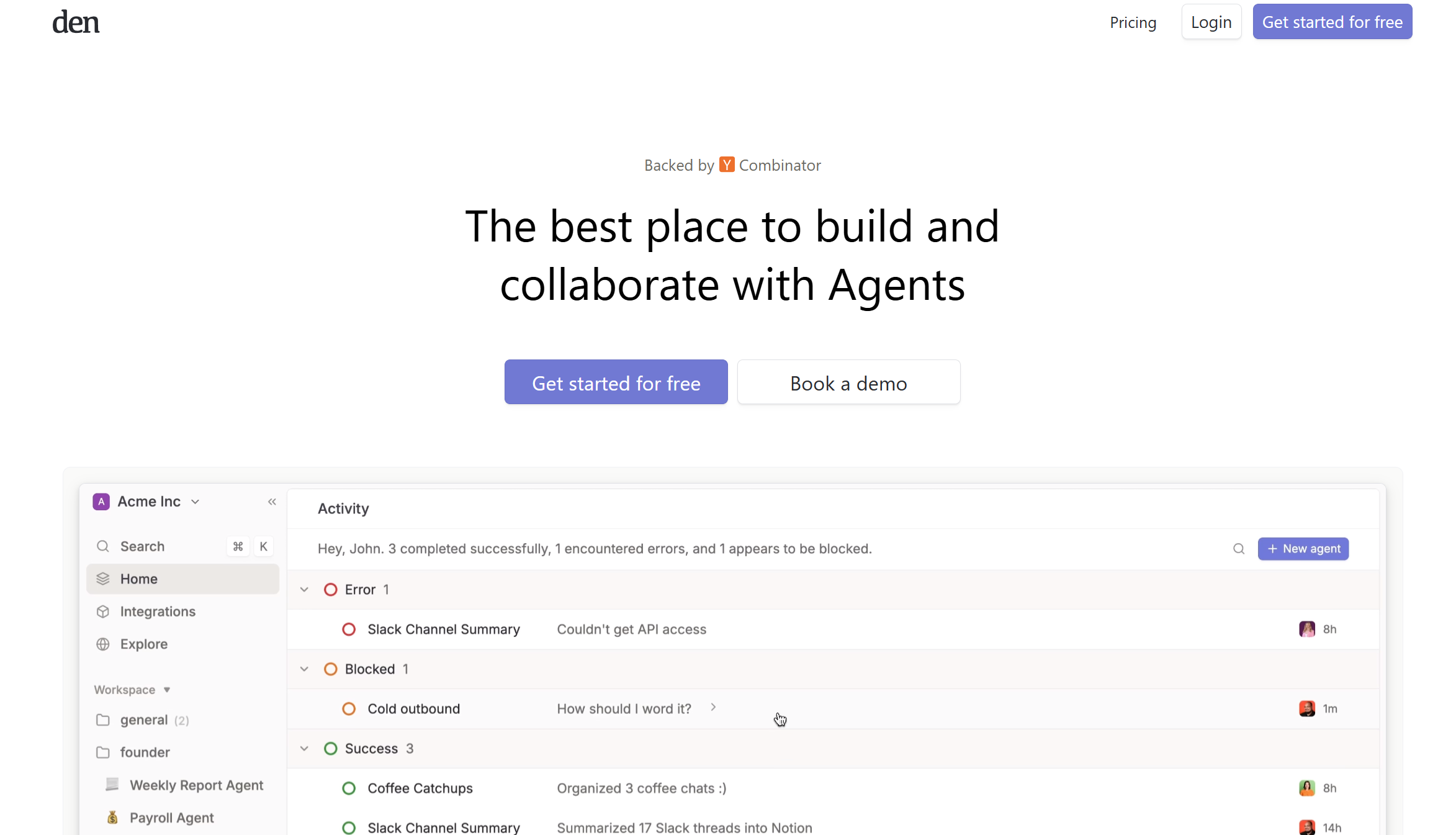
- Den has shifted its focus to a multiplayer AI agent builder, allowing multiple users to collaborate in real time.
- The pivot reflects growing demand for collaborative AI development environments that combine shared workspaces, live editing, and integrated deployment.
- Multiplayer functionality may help teams rapidly prototype, iterate, and refine AI agents without the friction of version conflicts.
- The move positions Den to compete with both traditional no-code AI builders and developer-focused agent frameworks.
- The pivot follows industry momentum toward multi-agent systems, cooperative AI workflows, and integration with enterprise tools.
Den has officially pivoted its product strategy to become a multiplayer AI agent builder, aiming to provide a shared environment where multiple users can design, test, and deploy AI agents simultaneously. The shift marks a departure from whatever earlier focus the platform had and aligns with emerging trends in collaborative AI creation.
The multiplayer approach enables distributed teams to work together in real time—editing workflows, training prompts, adjusting logic, and debugging agents in parallel. This mirrors the “multiplayer” concept popularized by design platforms such as Figma, applied here to the development of AI systems.
By supporting simultaneous edits and instant syncing across users, Den could address one of the persistent challenges in AI agent development: coordination. In many current tools, changes must be serialized or merged manually, slowing iteration and increasing the risk of errors. A live, collaborative editor allows for faster experimentation and a more dynamic feedback loop between designers, developers, and stakeholders.
The pivot also taps into the momentum around multi-agent systems, where several AI agents work together—sometimes with humans in the loop—to accomplish complex tasks. A multiplayer builder could streamline how teams design agent interactions, test handoffs between agents, and deploy them into integrated environments.
Competition in the AI agent development space is growing quickly. No-code builders such as Adept, Cognosys, and Flowise cater to non-technical users, while frameworks like LangChain, AutoGen, and Haystack appeal to developers. Den’s focus on multiplayer collaboration could help it carve out a differentiated niche, particularly for enterprise teams or startups working on time-sensitive AI products.
To succeed, Den will likely need to integrate with popular developer tools, data sources, and deployment platforms, while maintaining a smooth, low-latency collaboration experience. Security, version control, and role-based permissions will also be essential for adoption in professional environments.
If the pivot delivers on its promise, Den could become a go-to platform for collaborative AI creation—much like Figma did for design—by making it easier for teams to jointly shape, refine, and launch AI agents at scale.
Learn how AI Agents can supercharge your company’s profits and productivity at TMC’s AI Agent Event in Sept 29-30, 2025 in DC.
Rich Tehrani serves as CEO of TMC and chairman of ITEXPO #TECHSUPERSHOW Feb 10-12, 2026 and is CEO of RT Advisors and is a Registered Representative (investment banker) with and offering securities through Four Points Capital Partners LLC (Four Points) (Member FINRA/SIPC). He handles capital/debt raises as well as M&A. RT Advisors is not owned by Four Points.
The above is not an endorsement or recommendation to buy/sell any security or sector mentioned. No companies mentioned above are current or past clients of RT Advisors.
The views and opinions expressed above are those of the participants. While believed to be reliable, the information has not been independently verified for accuracy. Any broad, general statements made herein are provided for context only and should not be construed as exhaustive or universally applicable.
Portions of this article may have been developed with the assistance of artificial intelligence, which may have contributed to ideation, content generation, factual review, or editing.