Key Takeaways
• Adobe Experience Platform Agent Orchestrator brings agentic AI to customer experience, combining purpose-built Adobe agents with third-party tools.
• It uses a conversational UI, reasoning engine, operator modules, and a knowledge base to interpret goals and execute multi-step workflows.
• The system emphasizes human oversight, enterprise-grade trust, and extensibility for customized use cases.
• Ten initial agents—like Audience, Data Insights, and Brand Concierge—help automate campaigns, personalization, and performance optimization.
• Adobe’s focus on responsible AI, data governance, and cross-ecosystem collaboration positions Agent Orchestrator as a platform for scalable business automation.
What Is Agent Orchestrator?
Adobe Experience Platform Agent Orchestrator adds an agentic layer to the existing Experience Platform. According to Akintunde Ajayi, Group Product Marketing Manager, it “lets agents understand specific customer experience tasks, make decisions, and take actions—all with human oversight.” This isn’t just a chatbot—it’s a structured multi-agent orchestration engine designed for enterprise use.
The system supports collaboration between Adobe-produced agents and those from external providers, creating a dynamic environment where AI can span the full breadth of marketing, analytics, and customer journeys.
Behind the Architecture: How It Works
The platform is built around five key components that work in tandem:
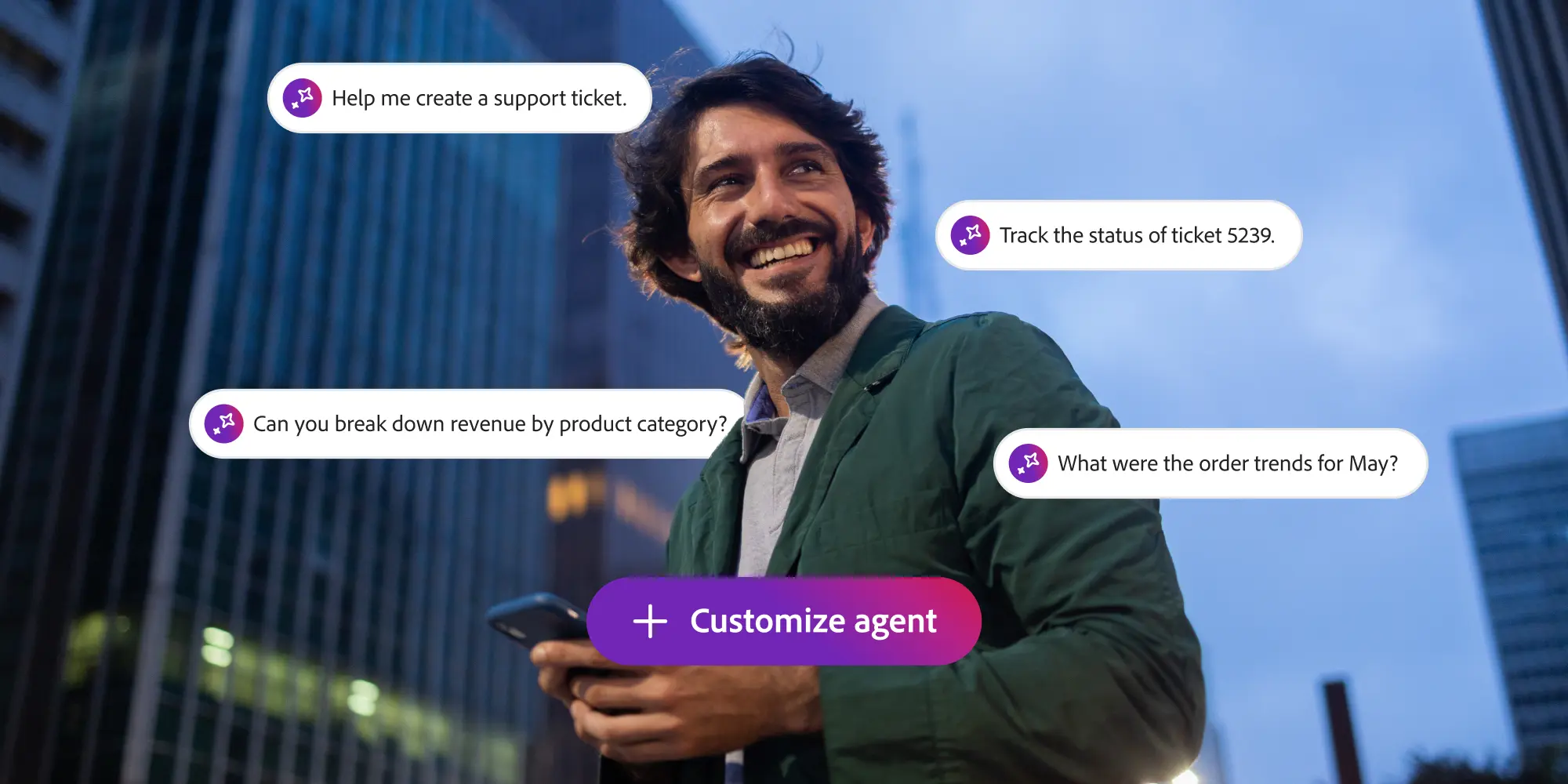
- Conversational Interface – Accessible as a chat UI within Adobe Experience Platform, it enables users to communicate with agents in natural language.
- Reasoning Engine – This layer breaks down user goals and plans multi-step tasks.
- Agentic Operators – Discrete modules perform actions like data queries, content creation, or site optimization.
- Knowledge Base – Holds domain-critical information, priority rules, and grounding data to guide agent behavior.
- Agent Composer – An upcoming UI that lets users customize and chain multiple agents for bespoke workflows.
In practice, a marketing user might ask: “Find high-potential audience segments, build an email campaign, and schedule it.” The Orchestrator interprets the request, invokes relevant operators and agents (from Audience Agent, Content Production Agent, etc.), and leaves human review and execution decisions to the user.
Real-World Use Cases and Agents
At launch, Adobe introduced ten pre-built agents designed with specific use cases in mind:
- Audience Agent: “Analyze engagement data and build goal-based audience segments.”
- Data Insights Agent: “Visualize and forecast customer behavior for experience optimization.”
- Content Production Agent: “Generate brand-guided content briefs and creative assets at scale.”
- Account Qualification Agent, Site Optimization Agent, Experimentation Agent, Journey Agent, Product Advisor Agent, and Workflow Optimization Agent round out the set—each handling a distinct area of campaign orchestration.
Adobe executives say these agents are built for creative and marketing teams who need to personalize, optimize, and scale experiences. Anil Chakravarthy, President of Digital Experience Business, emphasized, “Our focus is squarely on agentic offerings that are purpose-built for customer experience orchestration.”
Trust, Compliance, and Human Control
Trust sits at the heart of Adobe’s design philosophy for Agent Orchestrator. Ajayi notes that the platform ensures outputs “are high-quality, trustworthy, explainable, auditable, and transparent.” The system embeds multiple checkpoints—human approval, audit logs, and policy constraints—to maintain control over agent actions.
Human review is configurable within the workflow, enabling marketers or operations teams to validate decisions before deployment. This approach prevents unintended automation and ensures compliance with brand guidelines, data policy, and regulatory standards.
Ecosystem and Extensibility
Adobe recognizes that enterprise AI doesn’t operate in isolation. That’s why Agent Orchestrator is built to integrate with both third-party agents and internal tools.
Early partnerships include AWS, Microsoft, IBM, ServiceNow, SAP, Genesys, Workday, and others. These collaborations enable businesses to orchestrate across CRM, analytics, ERP, and support platforms—all under a unified agentic layer.
That extensibility continues within Adobe’s own suite: agents interface with Experience Manager Sites, Journey Optimizer, and Real-Time Customer Data Platform. For example, Site Optimization Agent adjusts site UX in real-time, while Journey Agent can refine multi-step campaigns across channels.
Brand Concierge: A New Customer-Centric Agent
One standout offering is Brand Concierge, an agentic assistant for front-line customer interactions. It guides users through purchase decisions with multimodal input—text, voice, images—while relying on first-party brand data and visual assets.
Chakravarthy described it as the evolution from transactional bots to a rich, guided buying experience: “Because it’s powered by content from Experience Manager and insights from Experience Platform, the Brand Concierge helps you personalize every engagement…all anchored in first‑party data to ensure reliability and brand compliance.”
Reporting, Optimization, and Collaboration
Beyond executing tasks, the platform supports full lifecycle monitoring. The combination of Agent Orchestrator and a unified data lake allows granular performance tracking—spotting which agents are effective, what content resonates, campaign flows, and conversions.
Adobe’s CFO, Dan Durn, emphasized the business potential: “We’ve introduced purpose-built AI agents that enhance daily workflow…generate capacity for customers to bring to life the magic of how they engage with their customers.”
By generating insights, recommendations, and dynamic content, the platform serves both practitioners and end-customers.
A Shift Toward Responsible Agentic AI
Adobe firmly positions Agent Orchestrator within its broader commitment to responsible AI. Governance features include:
- Semantic grounding in Adobe’s Experience Data Model
- Design reviews overseen by Adobe’s AI ethics board
- Secure handling of customer data and consent
- Human-in-the-loop checkpoints supported by policy-driven orchestration
- Audit and reporting mechanisms tied to enterprise security standards
Akintunde Ajayi remarked, “Trust is at the center of Adobe’s agentic AI solutions. Agent Orchestrator ensures AI outputs are…explainable, auditable, and transparent.”
Conclusion
Adobe Experience Platform Agent Orchestrator takes agentic AI from concept to enterprise in a purposeful, extensible, and governed manner. The system combines conversational interfaces with modular reasoning layers, ensuring human oversight and trust are built in from the ground up. Its ten initial agents automate marketing and CX processes while frameworks like Brand Concierge offer fresh customer-facing capabilities.
By embedding extensibility and ecosystem interoperability into the design, Adobe allows enterprises to tailor the agentic layer to unique workflows and platforms. With trust, transparency, and auditability engineered into every interaction, Agent Orchestrator offers a compelling path for organizations ready to deploy AI responsibly at scale.
Learn how AI Agents can supercharge your company’s profits and productivity at TMC’s AI Agent Event in Sept 29-30, 2025 in DC.

Rich Tehrani serves as CEO of TMC and chairman of ITEXPO #TECHSUPERSHOW Feb 10-12, 2026 and is CEO of RT Advisors and is a Registered Representative (investment banker) with and offering securities through Four Points Capital Partners LLC (Four Points) (Member FINRA/SIPC). He handles capital/debt raises as well as M&A. RT Advisors is not owned by Four Points.
The above is not an endorsement or recommendation to buy/sell any security or sector mentioned. No companies mentioned above are current or past clients of RT Advisors.
The views and opinions expressed above are those of the participants. While believed to be reliable, the information has not been independently verified for accuracy. Any broad, general statements made herein are provided for context only and should not be construed as exhaustive or universally applicable.
Portions of this article may have been developed with the assistance of artificial intelligence, which may have contributed to ideation, content generation, factual review, or editing.