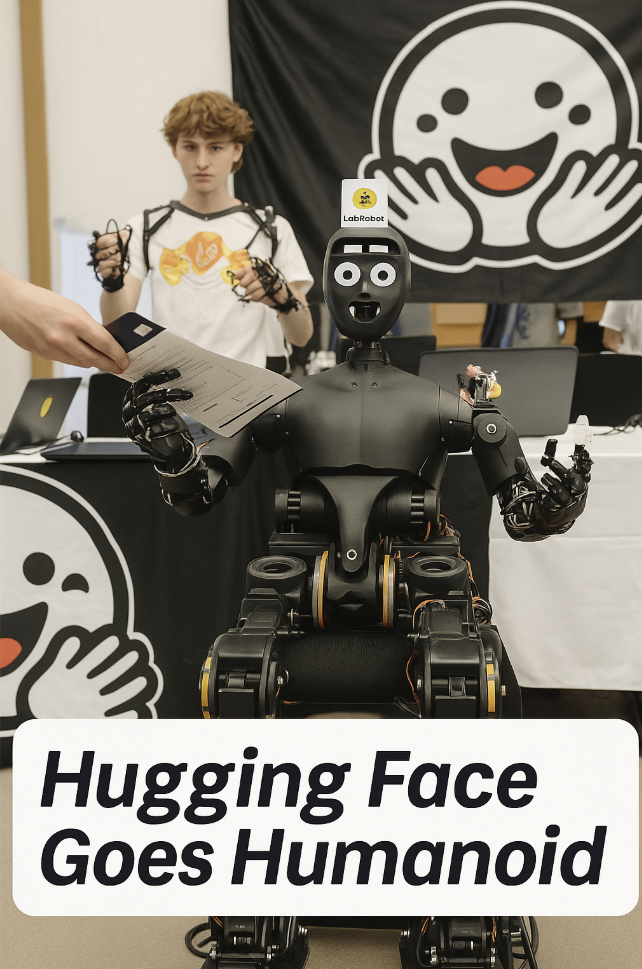
Hugging Face, best known for its leadership in open-source AI models, has taken a bold step into hardware with the unveiling of two humanoid robots—HopeJR and Reachy Mini. The announcement follows its recent acquisition of Pollen Robotics and signals a new ambition: to democratize robotics in the same way it helped democratize large language models.
The two robots differ in size, price, and purpose, but share a common goal—making robotics development more accessible to students, researchers, and independent developers.
3 Key Takeaways
- Hugging Face introduced HopeJR and Reachy Mini, two open-source humanoid robots designed to lower barriers to robotics R&D.
- The move places Hugging Face in direct conversation with well-funded competitors like Tesla Optimus and Figure, but with a developer-first, open-source approach.
- Both robots are designed to be affordable and modifiable, with the first units expected to ship by late 2025.
HopeJR is a full-size humanoid robot with 66 actuated degrees of freedom. It is capable of bipedal walking, object manipulation, and other complex movements. Despite its advanced functionality, Hugging Face plans to keep the price below $3,000—a fraction of the cost of many commercial humanoids on the market today.
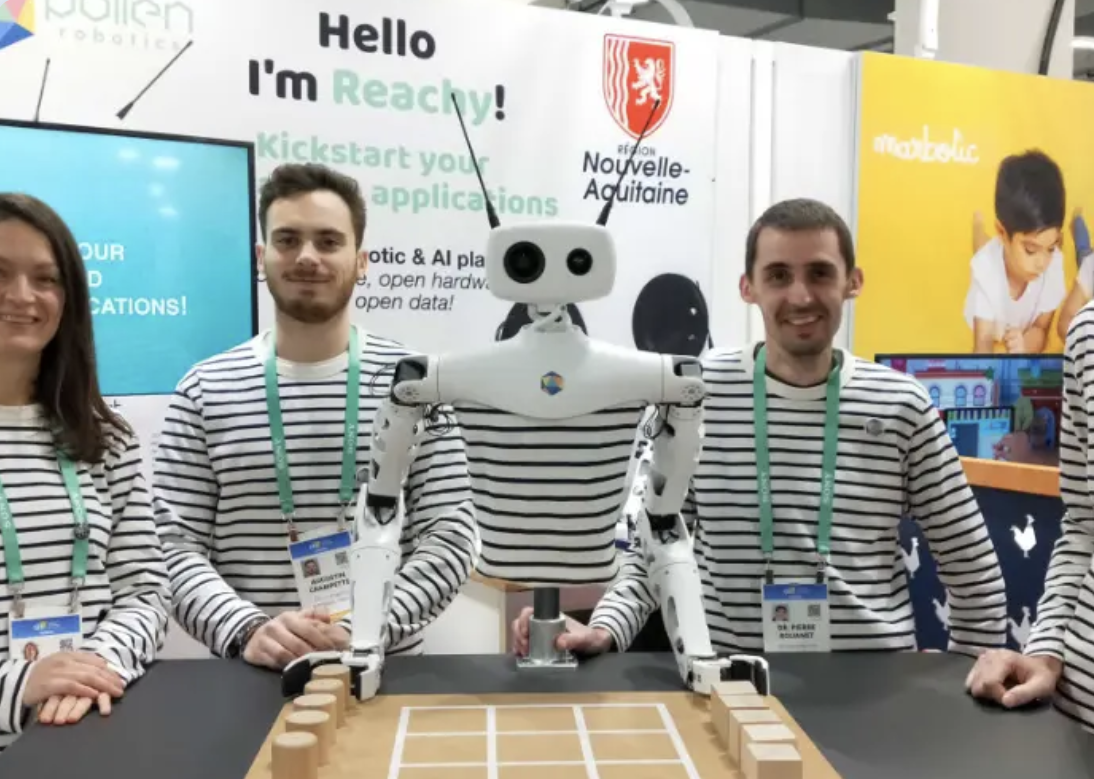
Reachy Mini is a smaller, desktop-sized robot priced between $250 and $300. It supports audio input, head movement, and limited physical interaction, making it well suited for natural language interfaces, classroom demonstrations, and lightweight AI prototyping.
Both robots are fully open-source. Their hardware schematics, software stacks, and interface documentation will be made publicly available, in line with Hugging Face’s mission to make AI development transparent, collaborative, and equitable.
“We want robots to be as hackable and as open as the models you can load from our platform,” said the company in its product announcement. A waitlist for early adopters is now live, and first shipments are expected to begin before the end of 2025.
Competition in the Emerging Humanoid Space
While Hugging Face is entering the robotics arena with an open, community-first mindset, it is stepping into an increasingly crowded and capital-intensive space.
Tesla’s Optimus robot, while still in development, is positioned as a manufacturing and logistics assistant. Figure AI, which has raised hundreds of millions in venture capital and formed partnerships with companies like BMW, is building humanoid robots for commercial deployment in labor-intensive sectors. Others like Sanctuary AI, Agility Robotics (backed by Amazon), and Apptronik are pursuing a mix of warehouse automation, retail support, and human-robot collaboration use cases.
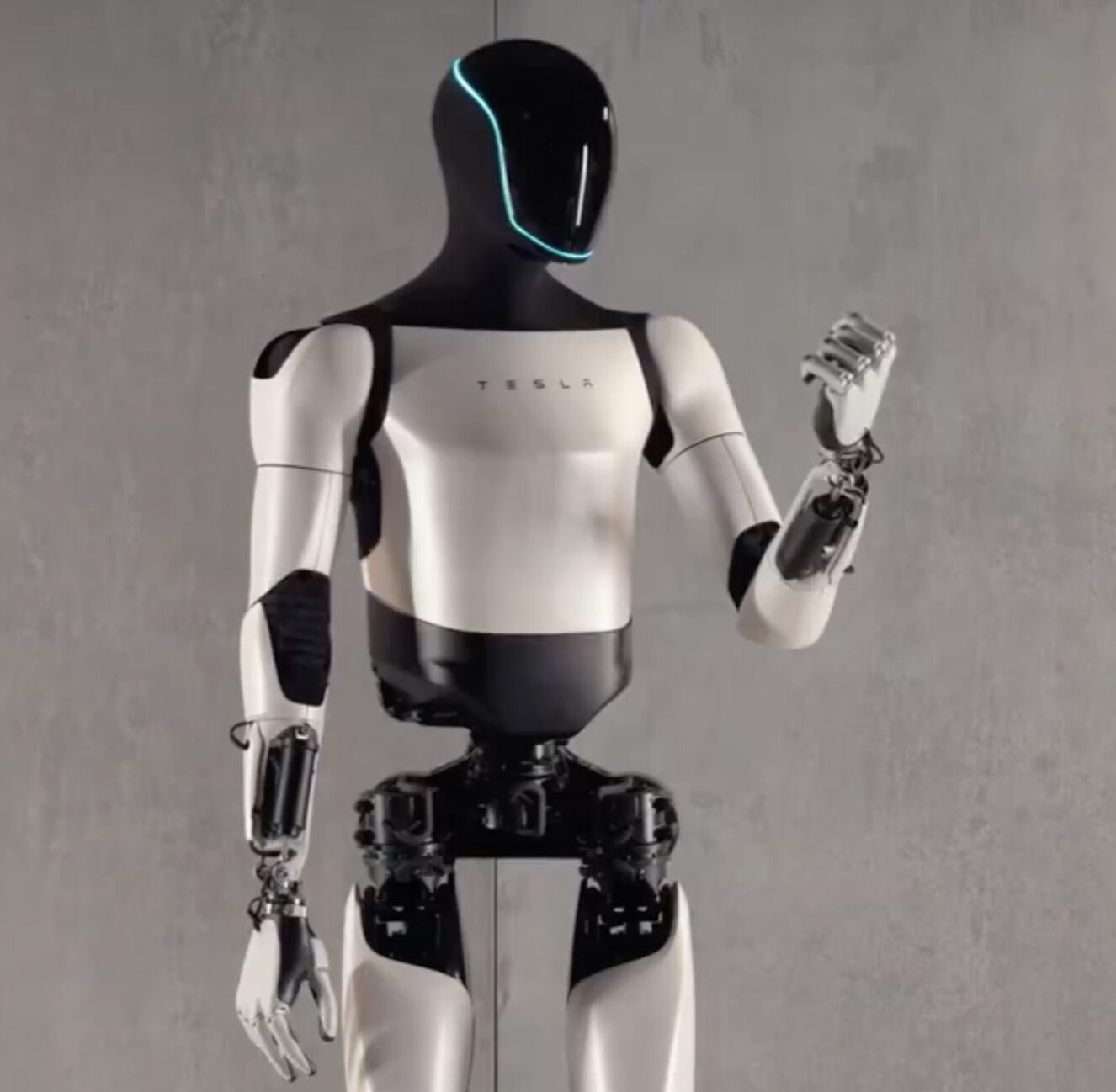
Most of these efforts focus on performance, strength, and industrial reliability. Hugging Face, by contrast, is leaning into flexibility, affordability, and education. Its robots may not be built for lifting boxes or assembling car parts, but they could become indispensable tools for developing the AI brains that run those machines—or for training the next generation of roboticists and AI researchers.
This also marks a significant hardware extension of Hugging Face’s platform. The company already plays a central role in the open-source machine learning ecosystem, offering a repository for models, datasets, and transformers. By adding physical robots to the stack, it is creating a full-loop development environment—from model training to real-world deployment and feedback.
Industry Outlook: Why This Matters
The robotics field is entering a period of accelerated convergence with generative AI. Large language models are increasingly being used to power planning, navigation, and human interaction capabilities in robots. Tools like OpenAI’s GPT-4, Google DeepMind’s Gemini, and Meta’s Llama are already being integrated into robotic systems for task planning, instruction following, and multimodal control.
What’s been missing, until now, is affordable hardware that lets developers experiment in a hands-on way. Most research institutions and early-stage companies simply cannot afford million-dollar humanoids or their associated proprietary software licenses.
That’s where Hugging Face’s release could prove pivotal. If it succeeds in building a community around HopeJR and Reachy Mini, it could dramatically widen the robotics R&D funnel—just as Raspberry Pi and Arduino once did for embedded systems.
There’s also the potential for long-term strategic positioning. As AI agents grow more capable, physical embodiments of those agents will be necessary for many real-world applications. Hugging Face’s decision to plant a flag in both AI and robotics gives it leverage in shaping the direction of this convergence.
Looking Ahead
Hugging Face’s move into robotics aligns with its long-term goal of open-access AI, but it also signals a deeper ambition—to influence how intelligence is embedded into physical systems. By lowering the barrier to robotics experimentation and giving developers direct access to robotic bodies, the company is helping to decentralize innovation in a space long dominated by defense contractors and deep-pocketed industrial labs.
If adoption follows the trajectory Hugging Face saw in open-source AI, HopeJR and Reachy Mini could do more than support research—they could help create a new generation of robotics startups grounded in transparency, community, and creative experimentation.
Learn how AI Agents can supercharge your company’s profits and productivity at TMC’s AI Agent Event in Sept 29-30, 2025 in DC.

Aside from his role as CEO of TMC and chairman of ITEXPO #TECHSUPERSHOW Feb 10-12, 2026, Rich Tehrani is CEO of RT Advisors and a Registered Representative (investment banker) with and offering securities through Four Points Capital Partners LLC (Four Points) (Member FINRA/SIPC). He handles capital/debt raises as well as M&A. RT Advisors is not owned by Four Points.
The above is not an endorsement or recommendation to buy/sell any security or sector mentioned. No companies mentioned above are current or past clients of RT Advisors.
The views and opinions expressed above are those of the participants. While believed to be reliable, the information has not been independently verified for accuracy. Any broad, general statements made herein are provided for context only and should not be construed as exhaustive or universally applicable.
Portions of this article may have been developed with the assistance of artificial intelligence, which may have contributed to ideation, content generation, factual review, or editing.