Key Takeaways:
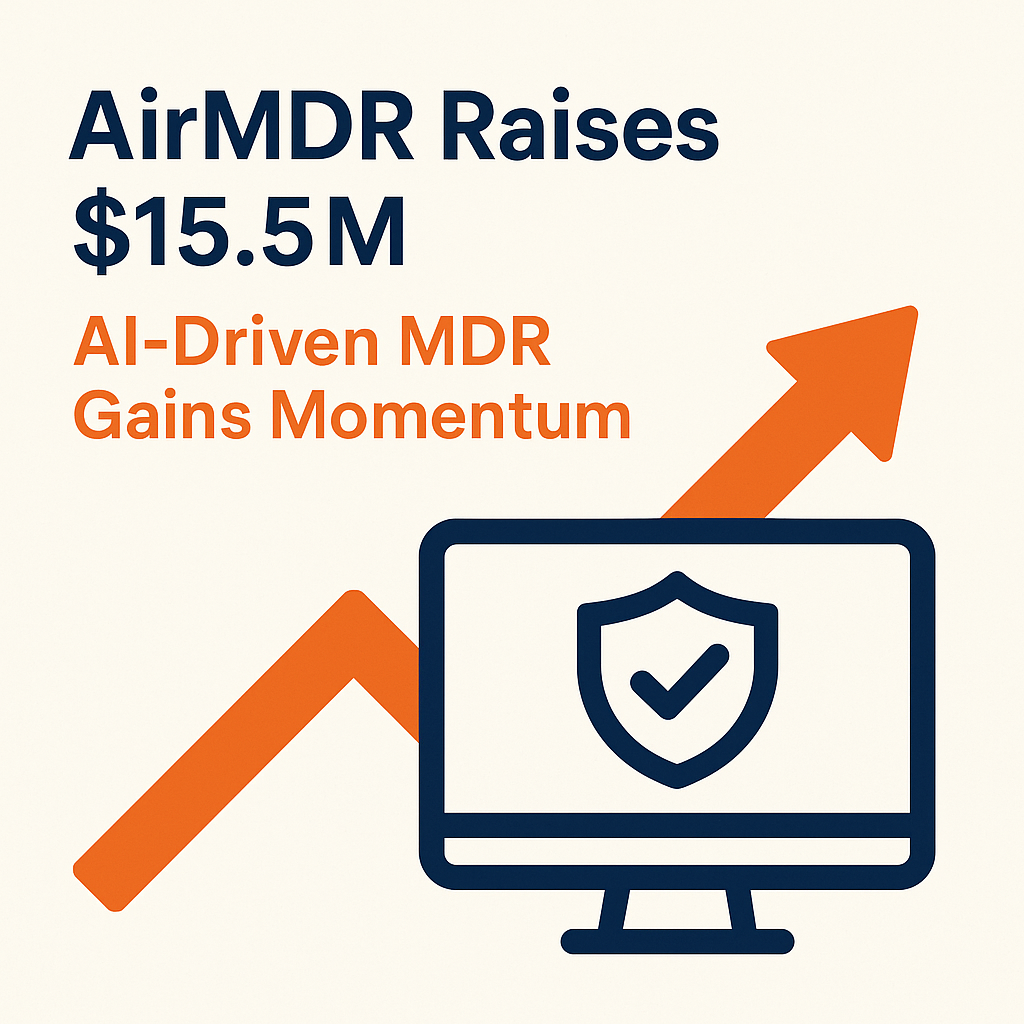
- AirMDR raised $15.5 million to develop its AI-native managed detection and response (MDR) platform.
- The platform combines a “Virtual Analyst” with human oversight to streamline threat response.
- Competitors include ReliaQuest, ActZero, WatchGuard, Guardz, and others offering AI-assisted security operations.
- The funding supports platform development, hiring, and expanded market outreach.
- AirMDR is led by Kumar Saurabh, whose prior companies include Sumo Logic and LogicHub.
AirMDR Secures $15.5M to Expand AI-First Managed Detection and Response Platform
AirMDR, a cybersecurity startup focused on delivering artificial intelligence-driven managed detection and response, has raised $15.5 million in seed funding to scale its platform and operations. The round includes $10.5 million in new capital, adding to $5 million raised earlier, and reflects continued interest in security solutions that integrate automation with expert oversight.
The company’s AI-native platform uses what it calls a “Virtual Analyst” to automate triage and threat detection workflows. Human analysts then validate and act on high-priority events, balancing speed and consistency with situational awareness.

AirMDR CEO and co-founder Kumar Saurabh said the company is focused on helping security teams do more with less.
“Our goal is to bring the capabilities of a fully staffed SOC to organizations that can’t afford the cost or complexity of building one themselves,” said Saurabh. “We believe AI can reduce the noise and free up security teams to focus on what really matters—remediation and prevention.”
Saurabh previously co-founded LogicHub and served as founding VP of engineering at Sumo Logic, experience that shaped AirMDR’s focus on scalable security analytics and cloud-native delivery.
A Crowded but Expanding Field
AirMDR’s entry adds to a field of MDR providers increasingly incorporating AI to improve performance and efficiency.
ReliaQuest, one of the best-known players in the space, raised over $500 million and serves large enterprises through its GreyMatter platform. The solution integrates hundreds of security tools and uses advanced automation to reduce mean time to detect and respond. According to the company, GreyMatter supports clients across regulated industries including financial services and healthcare.
ActZero, backed by $70 million in funding, combines machine learning with human security experts to deliver MDR to mid-sized organizations. Its platform focuses on lowering false positives and tailoring threat response to each client’s environment.
WatchGuard Technologies, traditionally known for firewall and endpoint security, recently introduced Total MDR—a full-stack service built for MSPs supporting small and mid-sized businesses. The company says its approach blends AI detection with human-led investigation and integrates signals across multiple vectors including identity and cloud.
Guardz, another emerging competitor, raised $56 million to expand an AI-native cybersecurity platform targeting SMBs via MSPs. Its model combines threat detection with risk reporting, compliance tools, and cyber insurance integrations.
Other providers in this space include UnderDefense, BitLyft, and Wirespeed, each with a focus on combining automation with active security monitoring and analyst support.
Human analysts validate information from Virtual Analysts and act on high-priority events, balancing speed and consistency with situational awareness.
AirMDR’s Approach
AirMDR differentiates itself with an AI-first model designed from inception for automated triage and workflow coordination. The “Virtual Analyst” handles as much as 80% of alerts, with security experts stepping in for validation and resolution. This structure aims to improve responsiveness without adding operational overhead.
“We didn’t want to retrofit AI into an old stack—we built our platform around it,” said Saurabh. “That lets us streamline detection and response in ways legacy systems struggle to replicate.”
The company is targeting organizations that have security requirements but lack the resources to build internal SOCs—often mid-sized businesses or IT providers seeking a white-label solution.
The new capital will be used to expand AirMDR’s engineering team, enhance platform functionality, and grow its customer base across North America and beyond. The company also plans to build out its partner ecosystem to support MSPs and IT consultants offering managed security services.
Context and Caution
MDR services have seen rising adoption as organizations face an evolving threat landscape and challenges staffing cybersecurity roles internally. However, expectations remain high and competition is increasing. Trust in automation—especially AI-powered decision-making—continues to be a concern for risk-conscious buyers.
Saurabh acknowledged the importance of balance:

“We believe AI is a force multiplier, not a replacement. You still need judgment, context, and control. Our job is to make sure the humans in the loop have what they need, faster.”
While automation can reduce alert fatigue and improve consistency, integration depth, reporting transparency, and scalability are all factors that influence long-term customer satisfaction. Larger players like ReliaQuest and SentinelOne already offer broad telemetry ingestion and compliance features, putting pressure on smaller firms to innovate while maintaining interoperability.
Market Outlook
The managed detection and response market is expected to grow steadily, with organizations seeking both technological agility and operational simplicity. AirMDR’s success will likely depend on its ability to differentiate on ease of deployment, analyst productivity, and measurable outcomes.
Its AI-native foundation, if validated through execution, could allow it to serve a segment of the market that is often underserved—organizations large enough to need security operations, but without the budget or time to manage them independently.
AirMDR’s funding signals continued investor interest in platforms that combine automation with accountability. While outcomes will vary by customer and use case, the company’s focus on scalable, blended detection and response aligns with broader industry movement toward intelligent, cost-aware security.

If you liked this post, you’ll love one of the leading global business communications and technology events since 1999, the ITEXPO #TECHSUPERSHOW, Feb 10-12, 2026 Fort Lauderdale, Florida.
Don’t forget the collocated MSP Expo – just for managed service providers!
Aside from his role as CEO of TMC and chairman of ITEXPO #TECHSUPERSHOW Feb 10-12, 2026, Rich Tehrani is CEO of RT Advisors and a Registered Representative (investment banker) with and offering securities through Four Points Capital Partners LLC (Four Points) (Member FINRA/SIPC). He handles capital/debt raises as well as M&A. RT Advisors is not owned by Four Points.
The above is not an endorsement or recommendation to buy/sell any security or sector mentioned. No companies mentioned above are current or past clients of RT Advisors.
The views and opinions expressed above are those of the participants. While believed to be reliable, the information has not been independently verified for accuracy. Any broad, general statements made herein are provided for context only and should not be construed as exhaustive or universally applicable.
Portions of this article may have been developed with the assistance of artificial intelligence, which may have contributed to ideation, content generation, factual review, or editing.