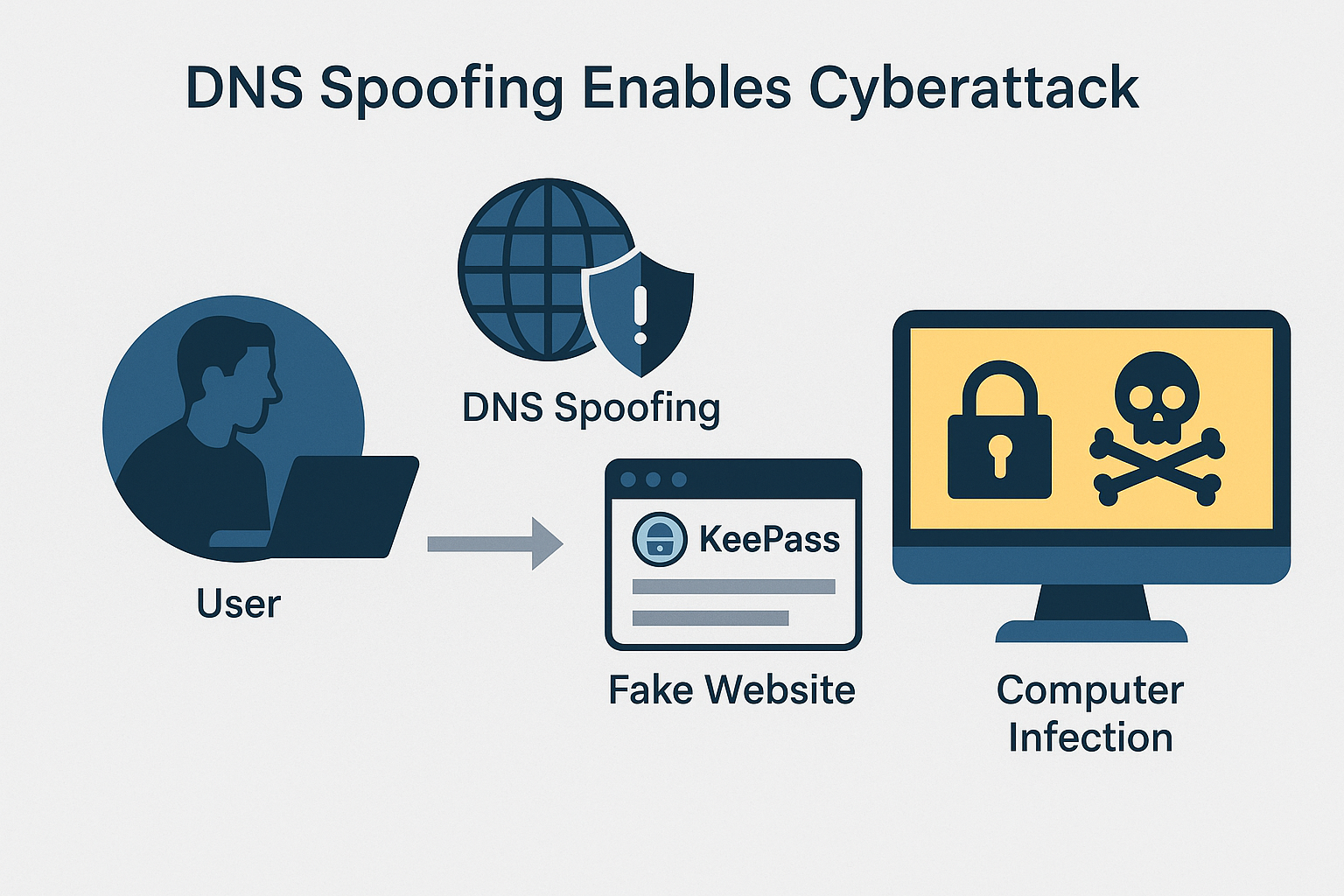
Security researchers have uncovered a sophisticated ransomware campaign that leverages a fake KeePass download site to compromise victims through credential theft and identity impersonation. The threat actors behind this operation used a common—but still highly effective—technique: registering a domain that closely resembled the legitimate password manager’s URL and driving users to download a trojanized installer.
The campaign illustrates how traditional phishing tactics are being retooled for more targeted, identity-based attacks. Instead of using mass emails, the attackers relied on more selective lures and a near-perfect replica of the KeePass website to trick users into installing malware.
Once a victim downloaded and executed the compromised installer, the attackers reportedly dropped a combination of remote access tools and ransomware. Researchers suggest this points to a two-phase operation: initial access via impersonation and credential harvesting, followed by monetization through extortion.
“This is a textbook example of how identity can be exploited as the first point of failure,” noted SC Magazine’s coverage. The attackers didn’t need zero-days or advanced exploits — they just needed trust and familiarity. By using a well-known brand like KeePass as the decoy, the attackers were able to sidestep many security defenses that typically flag unknown or suspicious downloads.
Notable Elements of the Attack
- Fake Site Imitation: The domain closely mirrored the official KeePass site, including branding and layout.
- Trojanized Payload: The download included ransomware, potentially combined with credential-stealing software.
- Identity Exploitation: The attackers used impersonation at the domain level to bypass trust barriers.
- Minimal Detection: Because the domain and installer appeared legitimate, early detection was difficult.
The event highlights a broader concern among cybersecurity professionals: ransomware is increasingly delivered via social engineering and identity fraud rather than technical exploits. As organizations emphasize threat detection, attackers are shifting to techniques that blend into trusted workflows and websites.
Security leaders are advised to:
- Revalidate domains for any critical tools or software before downloading updates
- Implement digital certificate validation and endpoint detection tools
- Train users to double-check URLs even when sites appear familiar
As identity-based threats evolve, vigilance and layered security remain critical defenses.
If you liked this post, you’ll love one of the the leading global business communications and technology events since 1999, the ITEXPO #TECHSUPERSHOW, Feb 10-12, 2026 Fort Lauderdale, Florida.
Don’t forget the collocated MSP Expo – just for managed service providers!
Aside from his role as CEO of TMC and chairman of ITEXPO #TECHSUPERSHOW Feb 10-12, 2026, Rich Tehrani is CEO of RT Advisors and a Registered Representative (investment banker) with and offering securities through Four Points Capital Partners LLC (Four Points) (Member FINRA/SIPC). He handles capital/debt raises as well as M&A. RT Advisors is not owned by Four Points.
The above is not an endorsement or recommendation to buy/sell any security or sector mentioned. No companies mentioned above are current or past clients of RT Advisors.
The views and opinions expressed above are those of the participants. While believed to be reliable, the information has not been independently verified for accuracy. Any broad, general statements made herein are provided for context only and should not be construed as exhaustive or universally applicable.
Portions of this article may have been developed with the assistance of artificial intelligence, which may have contributed to ideation, content generation, factual review, or editing