
The telecom industry has been talking about the end of POTS for years. For a long time, it felt theoretical. Something that would happen eventually.
That tone is changing.
At an industry event, I met in person with Kathy Mazza and Dave Beagle, who recently stepped into a Director of Channel Sales role, to discuss what they are seeing in the market and how they are approaching what is quickly becoming a very real transition.

“We’ve been talking about POTS replacement for six years,” Beagle said. “But now, with these deprecation notices, the market is actually moving.”
The inflection point came late last year.
“In November, we saw over 1,100 deprecation notices,” Mazza said, describing a wave of activity that pushed the issue from background noise to something partners can no longer ignore.
That acceleration aligns with broader carrier timelines.
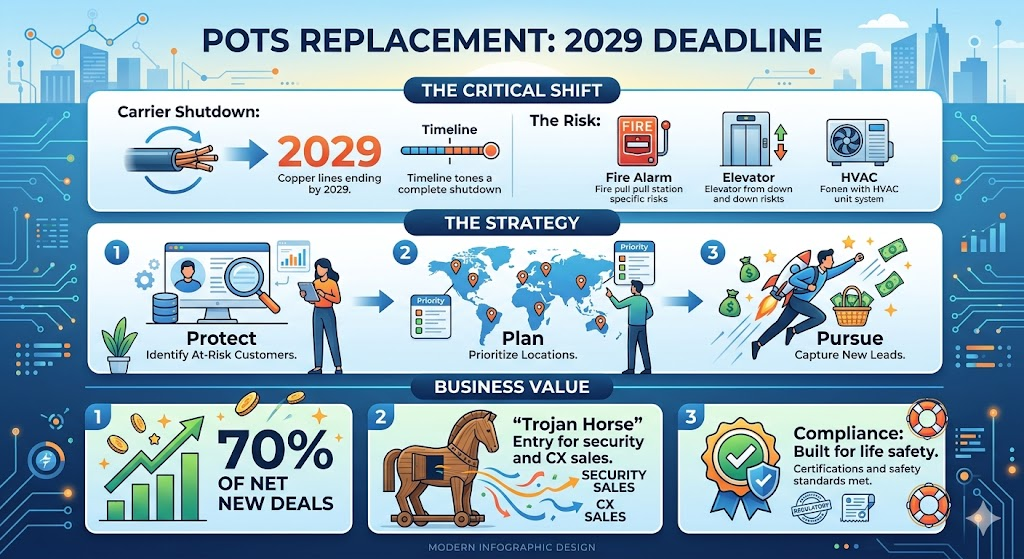
AT&T, for example, has indicated plans to shut down its remaining copper infrastructure by the end of 2029, with other providers expected to follow similar paths.
That creates a defined window.
And with it, a significant opportunity.
The challenge is that many customers and even partners are not fully aware of how widespread POTS still is.
“We all think fire alarms, elevators, security,” Beagle said. “But there are so many other applications out there.”
He pointed to examples that rarely come up in typical UC conversations.
HVAC systems. Environmental monitoring. Funeral home refrigeration. Emergency call boxes. Blue light phones on university campuses.
In many cases, these systems have been installed for decades and quietly depend on copper lines.

That creates both risk and urgency.
“You need a strategy,” Mazza said.
To address that, the company has built a tool designed to help partners identify where those risks exist and how to act on them.
The platform, referred to as a POTS tracking system, uses data around deprecation notices to map opportunity.
“It helps partners identify where those wireline shutdowns are happening so they can focus their efforts,” Beagle said.
The approach centers on what he described as three core actions.
Protect. Plan. Pursue.
First, partners can upload their existing customer base and cross reference it against deprecation data.
“That allows them to go back to their customers and say, you may be affected,” Beagle said.
Second, they can prioritize where to start.
In distributed environments, not every location carries the same urgency. The tool helps identify where changes will have the greatest impact.
Third, it can be used to generate new business.
“If you know where these wireline centers are being shut down, you can identify businesses in those markets and build a lead list,” Beagle said.
That combination turns what could be a reactive process into something more proactive.
And for partners, it changes the economics.
“This is driving about 70 percent of our net new opportunities,” Mazza said.
She pointed to real world examples.
“We have a partner that’s made almost a million dollars in the last three years just from POTS replacement,” she said.
Others are seeing five figure incentive payouts tied to similar deals.
But the opportunity is not just about revenue.
It is also about defense.
“Protect your base so nobody takes it,” Mazza said.
Because once a competitor steps in to handle a POTS transition, it often opens the door to broader conversations around connectivity, security, and communications.
In that sense, POTS replacement can act as an entry point.
“A Trojan horse,” as Beagle described it.
That entry point matters because many partners are currently focused on higher profile areas like AI, CX, and cybersecurity. Those opportunities can be larger, but they often come with longer sales cycles.
“This can fill the gap,” Mazza said.
There is also a structural shift in how these conversations are happening.
Traditionally, partners engage with IT teams. But many POTS dependent systems fall under facilities management.
“You might not be talking to the right person,” Beagle said.
That requires a different approach.
The company is supporting partners with campaign kits and messaging designed to reach the appropriate stakeholders, whether that is facilities, operations, or compliance teams.
Compliance itself is another factor.
POTS replacement often intersects with regulatory requirements, particularly in areas like fire safety, healthcare, and building management.
“This is a safety device,” Mazza said, emphasizing the importance of reliability and certification in these deployments.
The company has positioned its solution accordingly, focusing on purpose built hardware designed specifically for these environments rather than repurposed or bundled alternatives.
“We built it for fire and life safety from the ground up,” Beagle said.
That distinction can matter in regulated environments where inspectors and compliance bodies scrutinize how systems are implemented.
The broader takeaway is that POTS replacement is no longer a niche conversation.
It is becoming a large scale transition with defined timelines, measurable risk, and tangible economic impact.
For partners, the question is not whether it will happen.
It is whether they engage early or react later.
Because as copper networks continue to shut down, the opportunity will not wait.

If you liked this post, you’ll love one of the the leading global business communications and technology events since 1999, the ITEXPO #TECHSUPERSHOW, Feb 9-11, 2027 Fort Lauderdale, Florida. All the POTS replacement solutions that matter, will be there!
Don’t forget the collocated MSP Expo – just for managed service providers!
Aside from his role as CEO of TMC and chairman of ITEXPO #TECHSUPERSHOW Feb 9-11, 2027, Rich Tehrani is CEO of RT Advisors and a Registered Representative (investment banker) with and offering securities through Four Points Capital Partners LLC (Four Points) (Member FINRA/SIPC). He handles capital/debt raises as well as M&A. RT Advisors is not owned by Four Points.
The above is not an endorsement or recommendation to buy/sell any security or sector mentioned. No companies mentioned above are current or past clients of RT Advisors.
The views and opinions expressed above are those of the participants. While believed to be reliable, the information has not been independently verified for accuracy. Any broad, general statements made herein are provided for context only and should not be construed as exhaustive or universally applicable.
Portions of this article may have been developed with the assistance of artificial intelligence, which may have contributed to ideation, content generation, factual review, or editing