
Key Takeaways:
- AI agents are autonomous, goal-oriented systems capable of executing full workflows—not just answering questions.
- They offer measurable gains in speed, efficiency, and quality across functions like customer service, HR, finance, and IT.
- Successful deployment requires careful use-case selection, architecture planning, human oversight, and organizational alignment.
- Over 40% of companies plan to deploy agentic AI in the next year, but only those with clear strategy and safeguards will achieve ROI.
- This guide covers what AI agents are, how to build them, and how to avoid common pitfalls.
What Are AI Agents?
AI agents are a step beyond chatbots and copilots. While traditional AI tools respond to queries, AI agents pursue goals. They can reason, plan, use tools, and learn from context. For example, instead of just generating a draft email, an AI agent can autonomously pull data from a CRM, summarize it, generate a response, schedule a meeting, and follow up—all with minimal human input.
These agents are designed to operate within workflows, not outside of them. They take actions using APIs, databases, and other enterprise tools. Many also incorporate memory, allowing them to retain and apply context across tasks, making them more capable over time.
Recent surveys show that while nearly 80% of enterprises have deployed generative AI tools, less than 20% report significant financial or operational impact. Agentic AI has emerged as a promising fix to this disconnect. Unlike static copilots, agents can execute real, end-to-end work across departments, leading to higher returns.
Where AI Agents Add the Most Value
Not every workflow benefits equally from AI agents. The best use cases are those that are:
- Routine and repetitive
- Multi-step and rule-based
- Connected to existing systems (CRM, ERP, HRIS)
- Prone to bottlenecks or human error
- Time-sensitive or cost-intensive
Examples include:
- Customer Support: Automatically resolving tickets, escalating edge cases, and following up post-resolution
- Human Resources: Pre-screening candidates, scheduling interviews, preparing onboarding documentation
- Finance: Reconciling invoices, preparing credit memos, flagging anomalies in expense reports
- Sales: Researching prospects, preparing call summaries, triggering CRM updates
- IT Services: Password resets, account provisioning, tier-one ticket management
Studies have shown that AI agents can improve productivity by 30–90% in back-office functions and reduce processing time by up to 60% in frontline support roles.
Anatomy of an AI Agent
A well-designed AI agent typically consists of five core components:
- Planner: Decomposes the user’s objective into smaller tasks.
- Executor: Calls tools, APIs, or models to perform each task.
- Memory: Stores contextual information across tasks or sessions.
- Reasoner: Evaluates outputs and determines next steps.
- Interface: Interacts with the user or system (e.g., chat, voice, email).
Imagine an HR agent tasked with scheduling interviews. It might begin by reviewing available candidates, identifying qualified matches, checking calendar availability, sending messages, updating the ATS, and finally logging the interaction in a report—all without human intervention unless a conflict or exception arises.
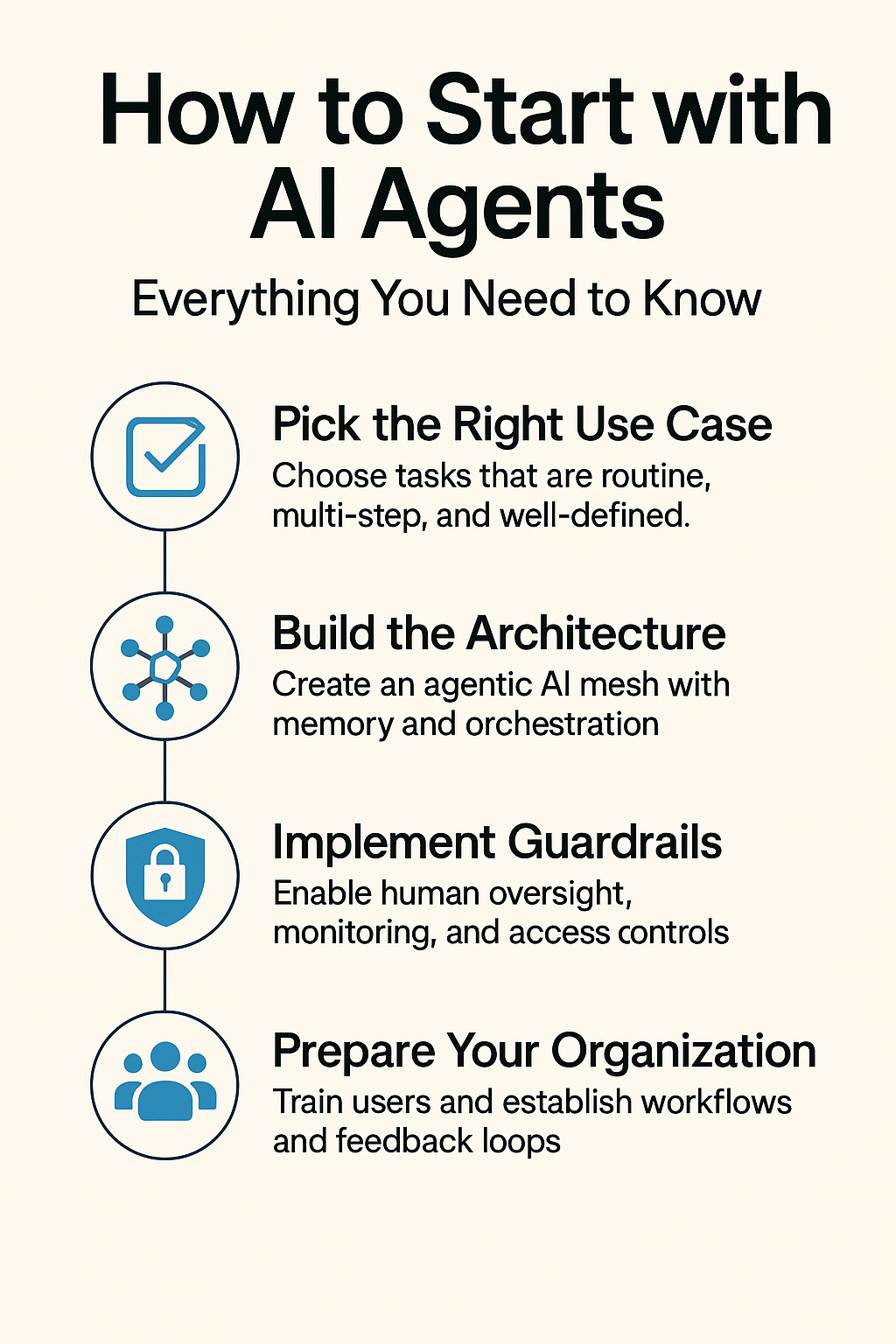
Step 1: Select the Right Use Case
Before diving into building or buying an agent, it’s crucial to align the use case with strategic priorities. Start with processes that are well-documented, low-risk, and measurable.
Ask:
- Does the task have a clear beginning and end?
- Are the inputs and outputs structured or semi-structured?
- Is human judgment required every step—or only in exceptions?
- Can I clearly define success criteria (e.g., time saved, cost reduced, NPS improved)?
A common mistake is deploying AI agents into ambiguous or overly dynamic processes where human nuance is still essential. Start simple, measure impact, and scale from there.
Step 2: Choose Your Technical Approach
There are three primary ways to implement AI agents:
1. Use an Off-the-Shelf Platform
Several vendors now offer agentic AI solutions pre-integrated into customer support, HR, or IT systems. These are faster to deploy but less customizable.
2. Build with Low-Code/No-Code Frameworks
Tools like LangChain, Dust, and Flowise let you stitch together LLMs, planners, databases, and APIs into functional agents without needing deep ML expertise.
3. Develop Custom Agents Internally
Enterprises with technical teams may prefer to build agents using LLM APIs (e.g., OpenAI, Anthropic), orchestration tools, and internal APIs. This offers the most flexibility but requires strong engineering, governance, and devops support.
When building from scratch, remember: orchestration, observability, and guardrails matter more than model size. A 6B-parameter model well-integrated into systems is often more useful than a 175B model without context or direction.
Step 3: Implement Governance and Guardrails
Autonomous systems without accountability are a recipe for chaos. Even if AI agents are efficient, they must be:
- Auditable: All actions should be logged and explainable.
- Constrained: Access should be limited to the minimum permissions needed.
- Monitored: Real-time alerts for failures, edge cases, or unexpected behavior.
- Reversible: Wherever possible, allow for rollback or confirmation before actions are finalized.
Consider deploying agents in “shadow mode” initially—let them make decisions and propose actions without executing. This helps test logic, identify edge cases, and build user trust.
Step 4: Prepare Your Organization
Technology alone won’t deliver ROI. Adoption depends on process readiness and team alignment.
- Train teams: Even business users should understand what agents do, how to trigger them, and when to override.
- Redesign workflows: Remove unnecessary handoffs, delays, or duplicative tasks that agents can handle better.
- Define KPIs: Measure impact through saved hours, improved response times, accuracy, and customer satisfaction.
- Establish feedback loops: Let users flag incorrect or incomplete outputs so agents can improve over time.
Companies that pair technical implementation with organizational change are 2–3x more likely to see lasting benefits from AI adoption.
Common Pitfalls to Avoid
- Deploying agents without use-case clarity
- Letting agents operate without oversight or logging
- Trying to replace human judgment in high-risk decisions
- Overengineering with massive models when a small one suffices
- Failing to align incentives—if people don’t use it, it doesn’t matter
Agentic AI is a force multiplier—but only if you start grounded and scale smart.
What Comes Next
The future of work will likely include agents embedded in every system, quietly taking care of tasks we used to do manually. But early success depends on realistic expectations, rigorous design, and constant feedback.
Start small. Pick the right problem. Use the right tools. Train your people. Monitor everything. Iterate.
Agentic AI isn’t a magic button—but for businesses willing to put in the work, it offers an entirely new model of scale.
Learn how AI Agents can supercharge your company’s profits and productivity at TMC’s AI Agent Event in Sept 29-30, 2025 in DC.

Rich Tehrani serves as CEO of TMC and chairman of ITEXPO #TECHSUPERSHOW Feb 10-12, 2026 and is CEO of RT Advisors and is a Registered Representative (investment banker) with and offering securities through Four Points Capital Partners LLC (Four Points) (Member FINRA/SIPC). He handles capital/debt raises as well as M&A. RT Advisors is not owned by Four Points.
The above is not an endorsement or recommendation to buy/sell any security or sector mentioned. No companies mentioned above are current or past clients of RT Advisors.
The views and opinions expressed above are those of the participants. While believed to be reliable, the information has not been independently verified for accuracy. Any broad, general statements made herein are provided for context only and should not be construed as exhaustive or universally applicable.
Portions of this article may have been developed with the assistance of artificial intelligence, which may have contributed to ideation, content generation, factual review, or editing.