
Key Takeaways:
- Most enterprises using generative AI have yet to see meaningful business impact, despite widespread adoption.
- Agentic AI—autonomous systems with memory, planning, and orchestration—offers a path to material transformation.
- McKinsey outlines a CEO-led framework for embedding AI agents in core workflows, not just as tools but as collaborators.
- Real-world examples show substantial efficiency gains, faster turnaround times, and millions in cost savings.
- Success depends on redesigning processes, upskilling teams, and establishing strong data and governance foundations.
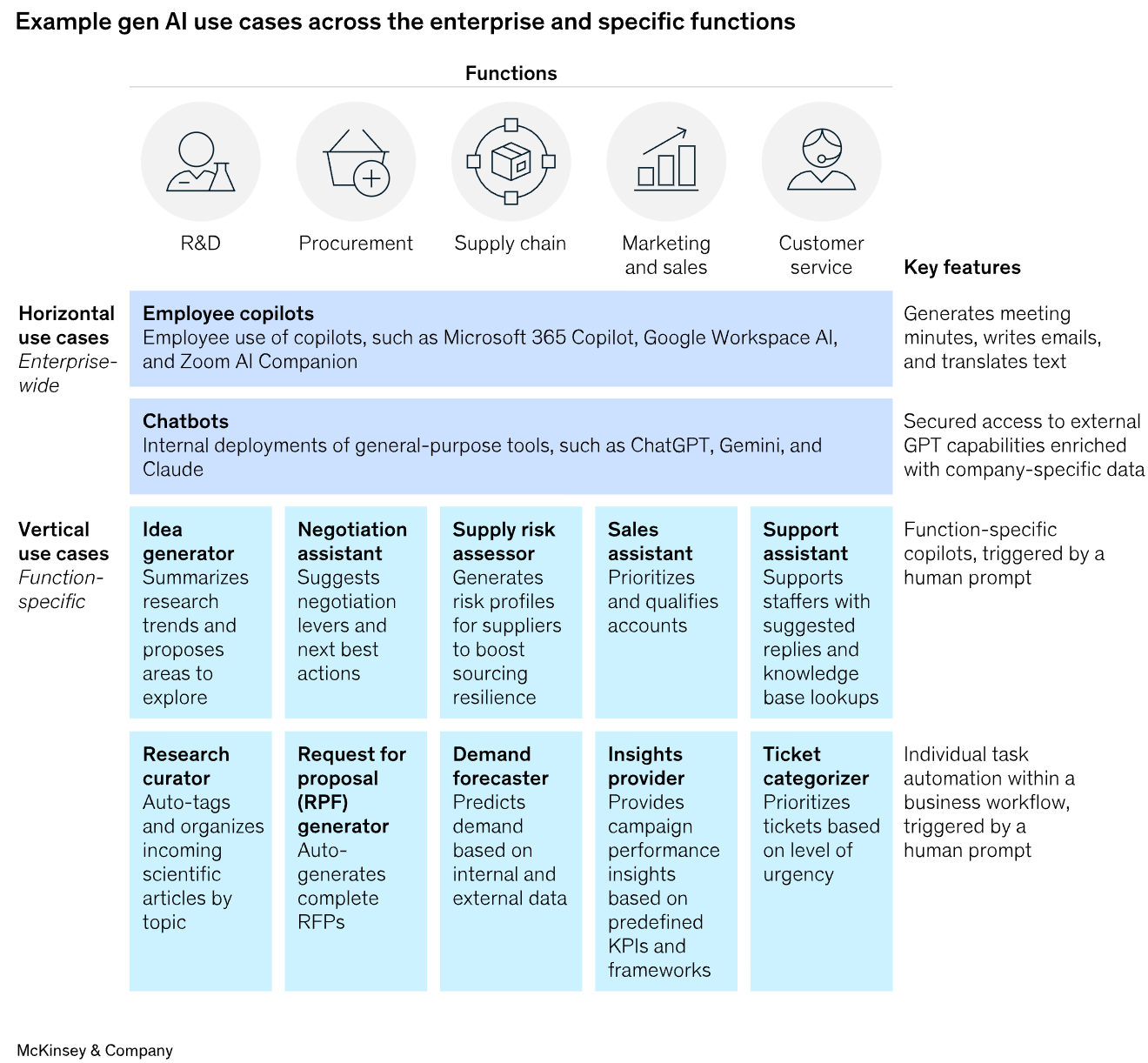
Despite the surge in generative AI adoption across industries, a familiar pattern is emerging: organizations are excited, but outcomes are underwhelming. According to a McKinsey report, about 80% of companies have implemented generative AI in some form. Yet nearly the same percentage report little or no measurable financial benefit. That gap isn’t about the technology—it’s about how it’s being applied.
McKinsey calls this the generative AI paradox: companies are investing in horizontal tools like chatbots, visual assistants, and writing copilots, but these rarely connect to revenue drivers or operational leverage. The solution, they argue, is a shift to Agentic AI—AI that doesn’t just support tasks but drives end-to-end workflows.
What Is Agentic AI?
Agentic AI refers to goal-driven, autonomous systems that combine four capabilities:
- Task planning: The ability to deconstruct high-level objectives into executable actions.
- Memory: Retaining and using context across multiple interactions and sessions.
- Tool orchestration: Using APIs, systems, and internal tools to act across applications and departments.
- Human oversight: Built-in escalation, auditability, and feedback to ensure reliability and trust.
These systems move beyond simple prompts and toward embedded intelligence—capable of driving processes from initiation to outcome.
Moving From Hype to Value
McKinsey’s framework outlines four pillars for realizing agentic AI’s potential:
- Strategic Focus: Companies should avoid generalized deployments and instead identify two or three high-value, vertical use cases—like R&D acceleration, supply chain optimization, or financial operations—where agents can directly improve outcomes.
- Workflow Integration: Agents should be embedded directly into business processes. This means reimagining workflows, not just dropping AI into legacy systems. The greatest gains come when tasks are redesigned with agents in mind.
- Organizational Enablement: Scaling agentic AI requires investment in infrastructure, cross-functional teams, and strong governance. It also calls for a new skills mix—one that combines domain expertise with prompt engineering, orchestration logic, and model evaluation.
- Leadership Accountability: Rather than isolated pilots, agentic AI should be part of a CEO-led transformation program with clear goals, performance milestones, and enterprise-wide alignment.
Agentic AI in Action
The report highlights companies already benefiting from this shift:
A market research firm was facing high client dissatisfaction due to human error in its data validation process. By deploying a network of AI agents to detect, explain, and resolve data anomalies using both internal records and external sources, it cut errors by 80%, reduced costs, and realized an annual savings of $3 million.
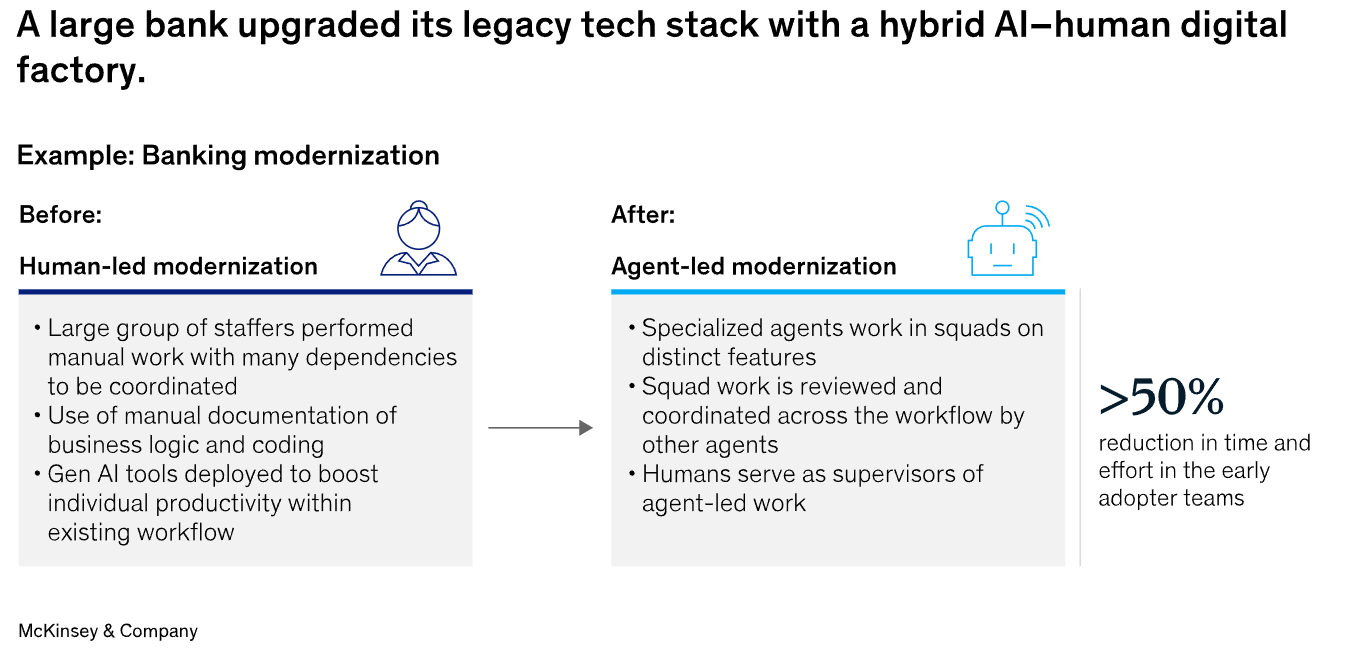
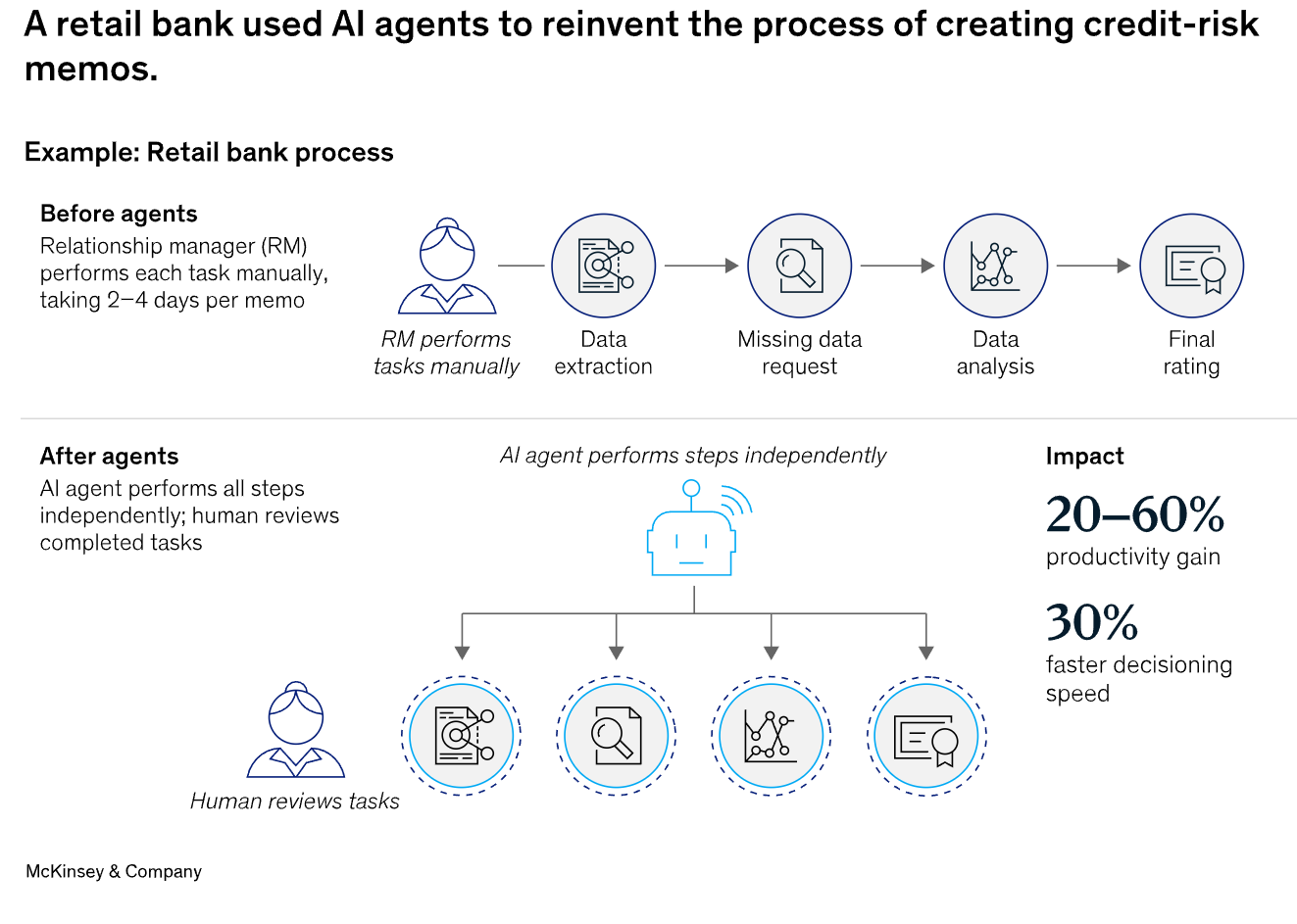
A large retail bank used AI agents to compile credit memos, pulling data from over 10 systems and automatically generating first drafts. Employees then reviewed and finalized them. This reduced turnaround time by 30% and improved team productivity by as much as 60%.
These aren’t hypothetical improvements—they’re measurable, repeatable, and scalable examples of agentic AI in production.
The CEO’s Role
McKinsey is clear: executives cannot delegate this shift to IT. Agentic AI is not just a software upgrade—it’s a business model evolution. To unlock impact, CEOs must:
- Identify priority domains where agents will change outcomes.
- Sponsor deep integration between business and technical teams.
- Invest in customized models, data pipelines, and prompt libraries tailored to their organization’s needs.
- Establish oversight structures to balance innovation with compliance and safety.
- Set performance targets and make agentic AI delivery part of business accountability, not a side project.
From Agents to Advantage
The power of agentic AI lies in its ability to reshape work. Done right, it doesn’t just reduce costs or increase speed—it redefines how businesses operate. Organizations can automate decision-making, reduce handoffs, improve accuracy, and ultimately generate new forms of value.
But the path to get there requires maturity. It means committing to full-stack transformation: from workflows to data infrastructure to governance. It means focusing on outcomes, not just interface. And it means treating AI agents not as novelties but as operational partners embedded in the fabric of the business.
As the report emphasizes, the real advantage isn’t adopting the newest tools. It’s being the company that turns those tools into system-wide performance gains—faster, safer, and at scale.
Learn how AI Agents can supercharge your company’s profits and productivity at TMC’s AI Agent Event in Sept 29-30, 2025 in DC.

Rich Tehrani serves as CEO of TMC and chairman of ITEXPO #TECHSUPERSHOW Feb 10-12, 2026 and is CEO of RT Advisors and is a Registered Representative (investment banker) with and offering securities through Four Points Capital Partners LLC (Four Points) (Member FINRA/SIPC). He handles capital/debt raises as well as M&A. RT Advisors is not owned by Four Points.
The above is not an endorsement or recommendation to buy/sell any security or sector mentioned. No companies mentioned above are current or past clients of RT Advisors.
The views and opinions expressed above are those of the participants. While believed to be reliable, the information has not been independently verified for accuracy. Any broad, general statements made herein are provided for context only and should not be construed as exhaustive or universally applicable.
Portions of this article may have been developed with the assistance of artificial intelligence, which may have contributed to ideation, content generation, factual review, or editing.