Key Takeaways:
- Accenture and Microsoft are integrating AI agents across security operations to improve triage, reduce alert fatigue, and increase detection accuracy.
- Microsoft’s Security Copilot platform will feature 11 AI agents, including six from Microsoft and five from partners like Tanium and OneTrust.
- Accenture’s Adaptive Managed Extended Detection and Response (MxDR) service is now powered by these AI agents and orchestration layers.
- These systems aim to automate low-level security tasks while routing high-value alerts to human analysts for final judgment.
- The collaboration addresses upstream attack signals such as data exfiltration, identity misuse, and suspicious cloud activity.
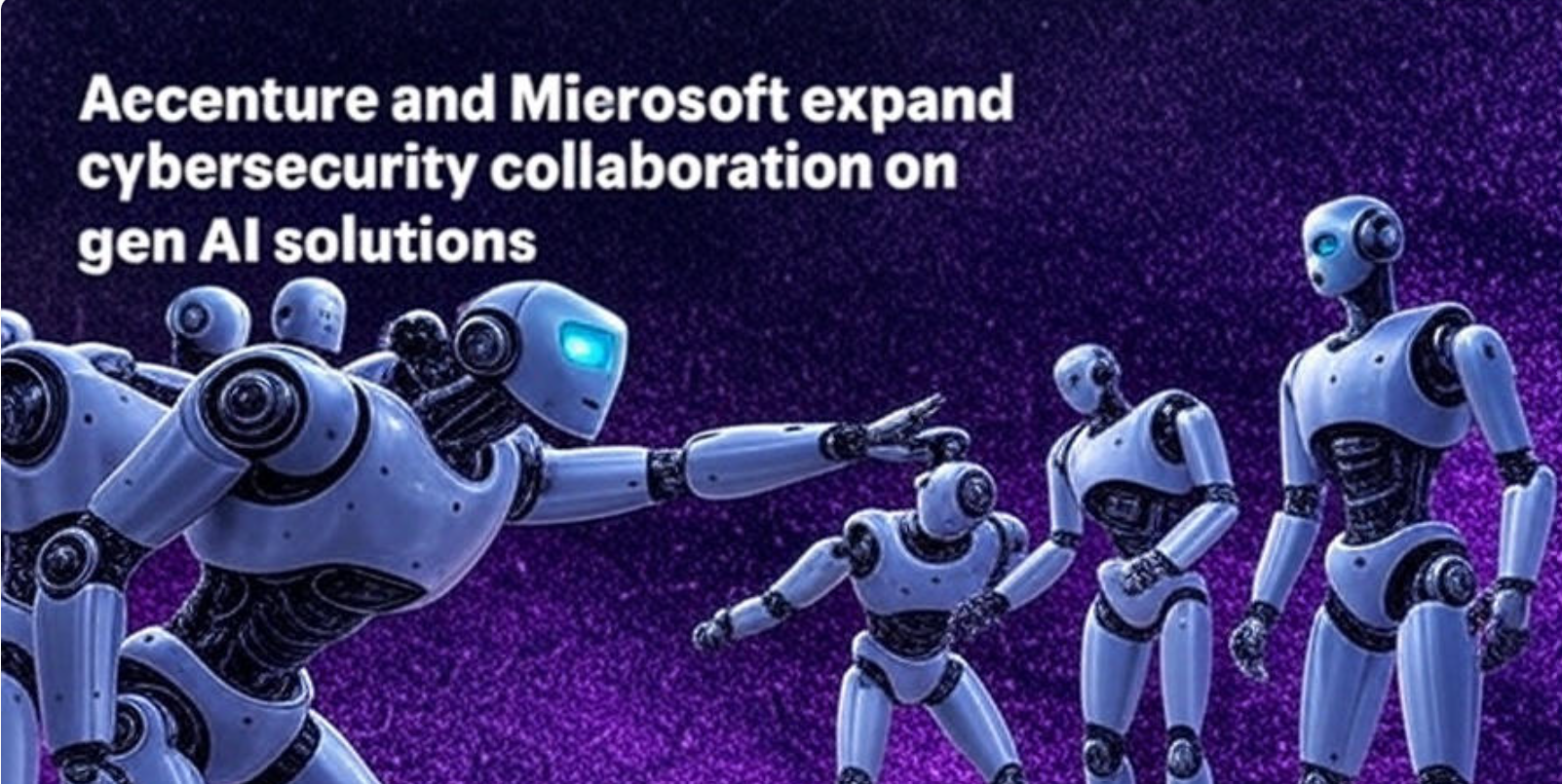
Accenture and Microsoft are expanding their strategic alliance by embedding agent-based AI throughout cybersecurity operations—a move designed to make detection, triage, and response more efficient and accurate across large-scale enterprise environments.
At the heart of the collaboration is Microsoft’s Security Copilot, a platform that hosts a growing suite of specialized AI agents. Each agent is responsible for a specific function, from monitoring phishing attempts to identifying risky sign-ins or analyzing abnormal file movements in cloud environments. Accenture’s Adaptive Managed Extended Detection and Response (MxDR) service now integrates these agents into a cohesive system—effectively turning multiple AI modules into a coordinated digital security team.
Unlike traditional rule-based automation, this approach relies on distinct AI agents that operate semi-independently, each gathering signals from disparate systems. An orchestration layer then compiles these outputs and decides whether to escalate them to a human analyst. This setup allows enterprises to reduce false positives, cut through noise, and focus on high-value alerts.
In practice, this could mean that one agent detects unusual access to a file stored on OneDrive while another observes a corresponding outbound network event. The orchestration agent synthesizes these insights and flags the behavior as a potential exfiltration attempt. A human analyst is then looped in to make a decision, combining automated efficiency with human discernment.
“The real power of this model lies in combining specialized agents with orchestration and oversight,” said a senior Accenture executive. “We’re seeing meaningful reductions in alert fatigue and faster time to response.”

This is part of Microsoft’s broader rollout of 11 AI agents within Security Copilot, including partner-developed modules from OneTrust, Tanium, BlueVoyant, and others. These agents are designed to be highly focused, helping enterprises automate repeatable tasks such as alert classification, incident prioritization, and initial response playbooks.
Accenture’s implementation goes further by incorporating these tools into broader enterprise environments, layering in identity and access controls, cloud security postures, and even automated data protection policies. The goal is not just faster triage but more intelligent triage—identifying threats earlier and more accurately.
As cybersecurity threats grow in complexity and volume, organizations are seeking scalable solutions that avoid overwhelming human analysts. By using AI agents that specialize, collaborate, and route only the most relevant insights, Accenture and Microsoft are positioning themselves at the forefront of what some are calling “agentic security architecture.”
While the concept is still maturing, the operational benefits are already apparent. Enterprises can reduce staffing burdens, respond more quickly to threats, and gain better visibility into upstream risks without adding manual layers. And unlike general-purpose AI copilots, these agents are designed from the ground up to work together and adapt to specific risk contexts.
The result is a new kind of cybersecurity framework—automated where it should be, human-guided where it must be, and capable of scaling in both scope and complexity. For organizations navigating today’s rapidly shifting threat landscape, the combination of AI-driven specialization and intelligent orchestration may offer a timely path forward.
Learn how AI Agents can supercharge your company’s profits and productivity at TMC’s AI Agent Event in Sept 29-30, 2025 in DC.

Rich Tehrani serves as CEO of TMC and chairman of ITEXPO #TECHSUPERSHOW Feb 10-12, 2026 and is CEO of RT Advisors and is a Registered Representative (investment banker) with and offering securities through Four Points Capital Partners LLC (Four Points) (Member FINRA/SIPC). He handles capital/debt raises as well as M&A. RT Advisors is not owned by Four Points.
The above is not an endorsement or recommendation to buy/sell any security or sector mentioned. No companies mentioned above are current or past clients of RT Advisors.
The views and opinions expressed above are those of the participants. While believed to be reliable, the information has not been independently verified for accuracy. Any broad, general statements made herein are provided for context only and should not be construed as exhaustive or universally applicable.
Portions of this article may have been developed with the assistance of artificial intelligence, which may have contributed to ideation, content generation, factual review, or editing.