Key Takeaways:
- The United States is pursuing a deregulated, market-led approach to AI, emphasizing free speech, data center growth, and ideological neutrality in federal use.
- China is advancing a tightly coordinated, state-led AI strategy grounded in self-reliance, censorship, and embedded political control, while aiming for global leadership by 2030.
- Washington sees AI as a competitive tool to preserve liberal democratic values and economic dominance; Beijing views AI as both a productivity engine and ideological instrument.
- U.S. AI models are developed largely by private firms with minimal federal constraint, while Chinese models operate under strict licensing, content review, and censorship protocols.
- Both countries are investing heavily in AI infrastructure and semiconductors, but diverge sharply on regulation, oversight, and the global norms they seek to promote.
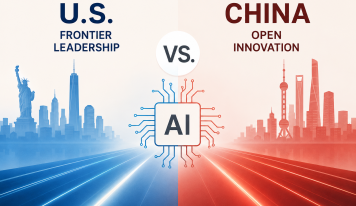
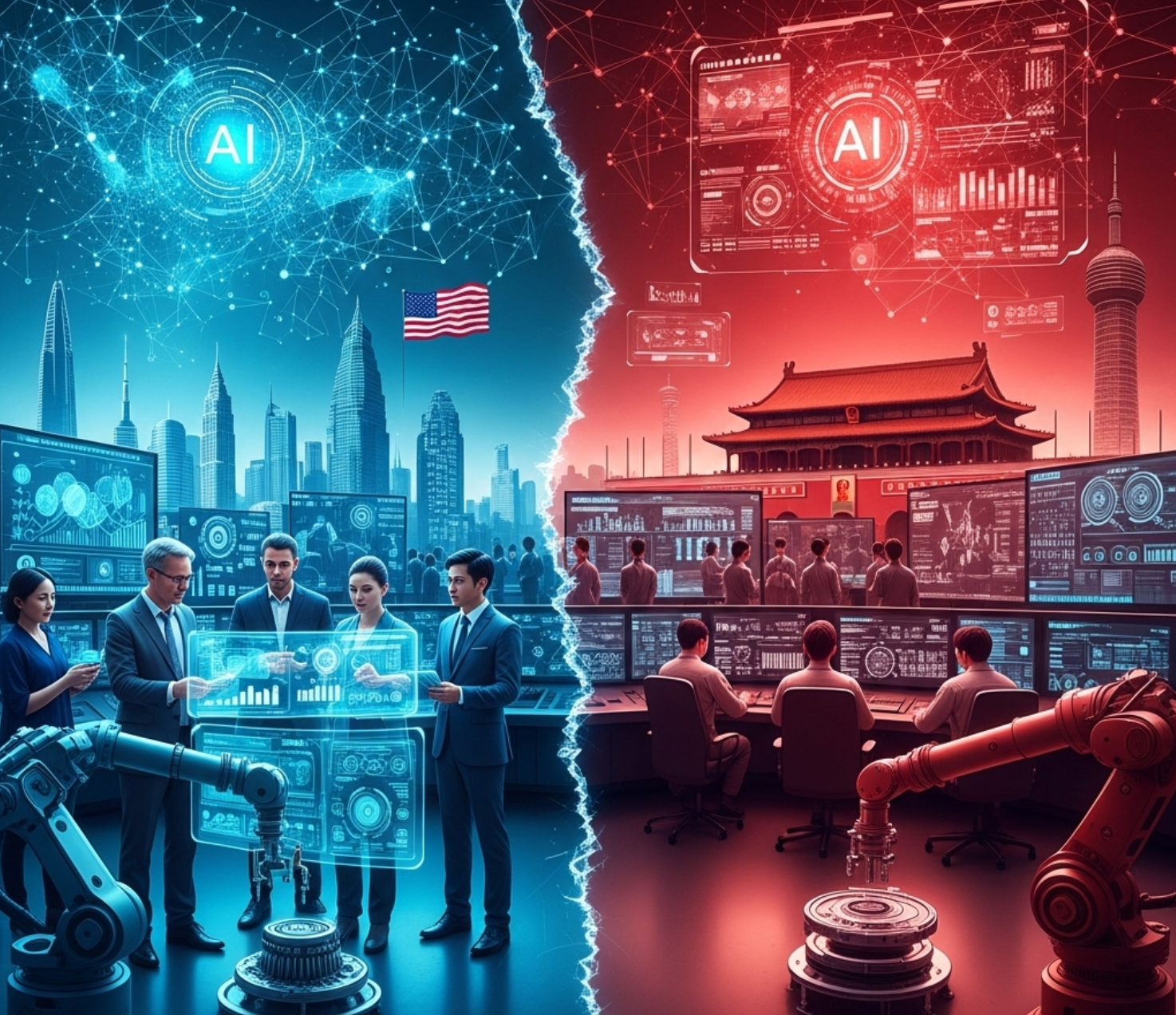
As artificial intelligence accelerates into the core of national policy and global economic planning, the United States and China are defining two fundamentally different models for its future. While both are investing billions into semiconductors, data centers, and AI research, they diverge in how they govern the technology, who controls its deployment, and what role it plays in shaping society.
On July 23, 2025, former President Donald Trump, alongside AI advisor David Sacks, unveiled a sweeping new AI policy dubbed “America’s AI Action Plan.” It rolled back the Biden-era executive order focused on AI safety and replaced it with a three-pronged federal mandate designed to reduce regulatory barriers, expand infrastructure, and enforce ideological neutrality in publicly funded AI systems.
The initiative fast-tracks data center permitting, removes environmental restrictions related to AI energy consumption, and preempts state-level AI regulations. It also requires that federal AI use only “non-woke” models, which the administration defines as free from political bias, though no mechanism for measurement was specified. In effect, the U.S. is doubling down on private-sector innovation, deregulation, and free expression as its key AI principles.
Critics of the plan note its lack of clarity around data rights, liability, and safeguards for model misuse. Supporters argue that the policy gives American companies the breathing room they need to innovate and outpace China in a technology arms race that spans both economic and geopolitical domains.
China, meanwhile, is shaping a very different future. Guided by long-term industrial policies like Made in China 2025 and the New Generation Artificial Intelligence Development Plan, Beijing is pushing toward full-stack domestic AI development—from chips to cloud infrastructure to language models—with the goal of becoming the global AI leader by 2030.
The Chinese approach is rooted in national self-reliance. In response to Western chip restrictions, China has poured state funding into semiconductor design and production. Government-backed funds such as Big Fund III and a dedicated AI Industry Investment Fund are directing billions toward manufacturing capacity, large model training, and cloud infrastructure.
China’s most notable progress has come in the form of models like DeepSeek, a ChatGPT rival that recently surged in domestic usage. While technically competitive, DeepSeek and others are subject to mandatory licensing from the Cyberspace Administration of China (CAC), which enforces ideological compliance through content controls embedded directly into model architecture.
This is where the two strategies sharply contrast. In the U.S., firms like OpenAI, Anthropic, and Meta operate with considerable autonomy. While there are growing calls for regulation, most AI development is left to market forces. In China, no generative AI model can be deployed publicly without CAC approval. The government requires firms to align outputs with “core socialist values” and avoid prohibited content areas, including dissent, political satire, and historical events like the 1989 Tiananmen Square protests.
Chinese AI developers embed censorship not only in front-end user interfaces but also in training data and post-processing layers. Testing by foreign researchers on models like DeepSeek reveals that while internal reasoning chains may process restricted concepts, the final output censors or reframes the response to comply with state rules.
Despite these restrictions, China’s AI infrastructure is expanding rapidly. Baidu, Alibaba, Tencent, Huawei, and state-owned enterprises are deploying AI in fields ranging from healthcare and education to industrial robotics and city governance. These deployments benefit from Beijing’s “whole-of-nation” model, where policy, investment, and regulatory enforcement are coordinated from the top down.
This stands in contrast to the U.S. model, where AI adoption is more fragmented. While firms like Microsoft, Google, and Amazon lead innovation, there’s no central authority directing their use of AI in public services. Instead, cities and states explore their own AI applications, often with little federal alignment.
Another difference lies in how each country approaches global leadership. Washington’s posture has leaned toward export controls, bilateral AI agreements, and promoting American-made systems in international markets. Beijing is proposing an entirely new global AI cooperation organization to set standards in areas like AI ethics, safety, and trade—an initiative designed to appeal to countries in the Global South looking for alternatives to U.S.-led frameworks.
For Beijing, controlling AI is not just about social harmony—it’s about retaining authority over the next era of communication and commerce. Generative AI poses a direct challenge to centralized narratives. That’s why China insists on licensing, data origin disclosure, and strict content governance. By embedding these principles early, Beijing aims to scale AI across public and private sectors without losing control over discourse.
The United States, in contrast, faces growing tensions between speed and safety. Critics worry that the Trump-Sacks approach may be too hands-off, leaving the country vulnerable to bias, disinformation, and misuse. But the administration’s bet is that ideological neutrality and minimal interference will give American companies a competitive advantage—both domestically and abroad.
Still, both models face risks. China’s emphasis on control may slow creative experimentation and isolate its AI ecosystem from global collaboration. The U.S. model, while more flexible, risks fragmentation – especially as states may enact a patchwork of regulatory minefields and policy inertia in the face of rapidly advancing technology.
Internationally, many countries are watching closely to see which approach yields the most sustainable balance of innovation and control. Europe has proposed its own path with the EU AI Act, which aims to regulate based on risk categories. But most developing countries will likely be pulled toward either the American or Chinese models—depending on their values, resources, and strategic interests.
Ultimately, the U.S. and China are not just building AI systems. They are projecting their national ideologies into the future of intelligence itself. Whether AI becomes a tool of open inquiry or centralized control may depend less on engineers than on policymakers—and the rules they’re willing, or unwilling, to write.
Learn how AI Agents can supercharge your company’s profits and productivity at TMC’s AI Agent Event in Sept 29-30, 2025 in DC.
Rich Tehrani serves as CEO of TMC and chairman of ITEXPO #TECHSUPERSHOW Feb 10-12, 2026 and is CEO of RT Advisors and is a Registered Representative (investment banker) with and offering securities through Four Points Capital Partners LLC (Four Points) (Member FINRA/SIPC). He handles capital/debt raises as well as M&A. RT Advisors is not owned by Four Points.
The above is not an endorsement or recommendation to buy/sell any security or sector mentioned. No companies mentioned above are current or past clients of RT Advisors.
The views and opinions expressed above are those of the participants. While believed to be reliable, the information has not been independently verified for accuracy. Any broad, general statements made herein are provided for context only and should not be construed as exhaustive or universally applicable.
Portions of this article may have been developed with the assistance of artificial intelligence, which may have contributed to ideation, content generation, factual review, or editing.