Key Takeaways:
• OpenRouter has closed a $40 million Seed and Series A round led by Andreessen Horowitz and Menlo Ventures, with backing from Sequoia and industry angels
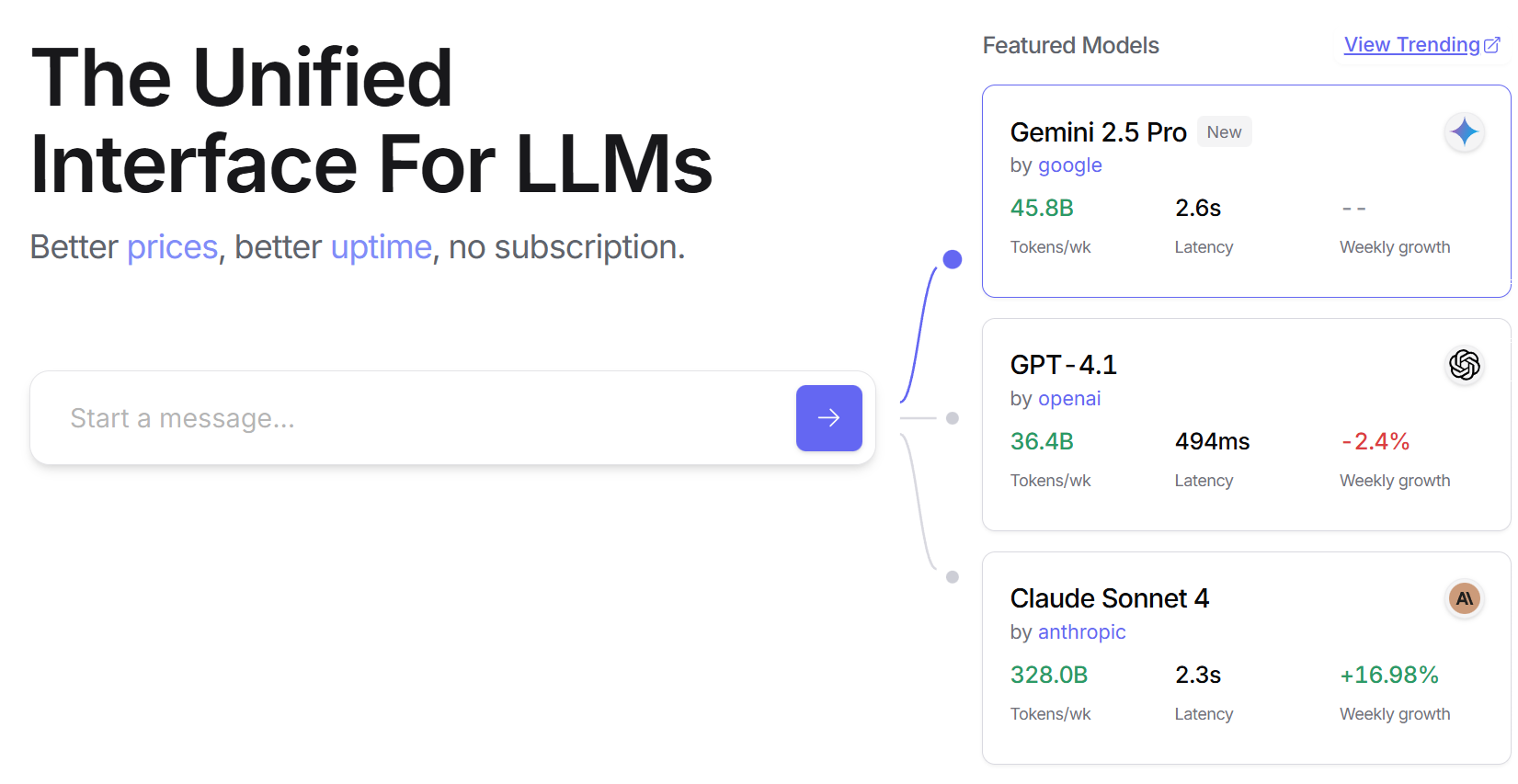
• The platform provides a unified API for LLM inference across 400+ models, with enterprise-grade uptime, privacy, and failover features
• With $100 million+ in annualized usage and over one million developers onboarded, OpenRouter is emerging as the go-to infrastructure layer for companies running multi-model AI stacks
OpenRouter, a company building the unified backbone for AI inference across large language models, announced that it has secured $40 million in combined Seed and Series A funding. The round was led by Andreessen Horowitz and Menlo Ventures, with participation from Sequoia Capital and several leading AI industry angels. The investment will fuel OpenRouter’s expansion into enterprise markets and accelerate development of its multi-provider routing and API platform.

OpenRouter’s core product is a single, standardized API that allows companies to route traffic across over 400 different large language models—from providers like OpenAI, Anthropic, Mistral, and Google—without needing to rewrite integrations or switch contracts. The platform has seen explosive growth in the past year, with usage scaling from $10 million in annualized inference spend in late 2024 to over $100 million by May 2025.
“Inference is the fastest-growing cost for forward-looking companies, and it’s often coming from four or more different models,” said Alex Atallah, OpenRouter’s co-founder and CEO. “The sophisticated companies have run into these problems already. They’re ripping out home-grown solutions and bringing in OpenRouter so they can focus on their domain-specific problems—not on LLM integration.”
Built with developer speed and enterprise guarantees in mind, OpenRouter delivers features like zero-logging, automatic multi-cloud failover, standardized token accounting, and edge-deployed infrastructure with under 25 ms overhead. Enterprises gain access to real-time spend monitoring, unified billing, and the flexibility to blend their own inference capacity with OpenRouter’s burstable infrastructure.
This architecture has attracted over one million developers since OpenRouter’s launch in 2023. The company now serves customers ranging from early-stage startups to multinational corporations, all routing critical workloads through the platform.
OpenRouter’s positioning has been strengthened by integrations with Microsoft VS Code, Zapier, Make.com, n8n, and Posthog. The company also played a key role in the stealth rollout of OpenAI’s GPT-4.1 model, giving customers early access and generating valuable inference feedback. According to OpenAI’s technical success team, OpenRouter’s active developer base has made it an important source of practical insights on real-world model performance.
“AI stacks are fragmenting,” said Anjney Midha, general partner at Andreessen Horowitz. “OpenRouter is unifying them with one API, one contract, and industry-leading uptime—exactly the kind of infrastructure play that defines new categories.”
Matt Murphy of Menlo Ventures echoed that sentiment, adding, “Professional developers are leaning into multi-model strategies and even optimizing performance across providers. OpenRouter’s hyper growth and rapid execution are strong indicators of a company that’s becoming essential to the AI economy.”
Enterprises are embracing OpenRouter as the connective tissue between a rapidly diversifying LLM landscape and their own proprietary tools, applications, and models. Whether companies are spending $500 per month or $5 million, OpenRouter offers the stability and abstraction layer needed to deliver consistent performance at scale.
“OpenRouter has been an early and enthusiastic collaborator on OpenAI models like GPT-4.1. Their diverse and active developer community has shared valuable feedback on how our models perform in practice. We’re excited to keep building alongside them as they help the world discover and use the latest LLMs,” said Tabarak Khan, Technical Success at OpenAI.
The platform’s no-compromise approach to privacy and compliance—paired with real-time reporting and token normalization—has made it an attractive choice for organizations concerned about data governance and unpredictable pricing. It also positions the company to become a trusted partner as enterprises evaluate how to structure their AI infrastructure in the face of increasing demand and rising costs.
Founded by Alex Atallah and Louis Vichy, OpenRouter launched in 2023 with a vision to remove the friction from multi-model development. Today, it powers billions of requests weekly and serves as a critical layer for teams navigating the complexity of today’s LLM ecosystem.
Conclusion
As enterprises grow increasingly reliant on multiple large language models, OpenRouter’s ability to unify inference, normalize usage, and ensure uptime is setting a new standard for AI infrastructure. With $40 million in new funding, deep partnerships with model providers, and accelerating customer demand, the company is poised to become the backbone of AI integration across industries. In a fragmented model ecosystem, OpenRouter’s value is clear: speed, simplicity, and stability for a multi-model future.
Learn how AI Agents can supercharge your company’s profits and productivity at TMC’s AI Agent Event in Sept 29-30, 2025 in DC.

Rich Tehrani serves as CEO of TMC and chairman of ITEXPO #TECHSUPERSHOW Feb 10-12, 2026 and is CEO of RT Advisors and is a Registered Representative (investment banker) with and offering securities through Four Points Capital Partners LLC (Four Points) (Member FINRA/SIPC). He handles capital/debt raises as well as M&A. RT Advisors is not owned by Four Points.
The above is not an endorsement or recommendation to buy/sell any security or sector mentioned. No companies mentioned above are current or past clients of RT Advisors.
The views and opinions expressed above are those of the participants. While believed to be reliable, the information has not been independently verified for accuracy. Any broad, general statements made herein are provided for context only and should not be construed as exhaustive or universally applicable.
Portions of this article may have been developed with the assistance of artificial intelligence, which may have contributed to ideation, content generation, factual review, or editing.