
Key takeaways
- China is accelerating robot adoption in factories to offset demographic pressures and rising labor costs.
- The government is backing the shift with policy support and visits from senior leaders.
- Domestic firms are increasingly supplying the “brains and nerves” of robots, reducing dependence on imports.
- Smaller manufacturers are now able to deploy robots thanks to falling costs and easier integration.
- The transition poses risks, including job displacement, integration hurdles, and geopolitical friction.
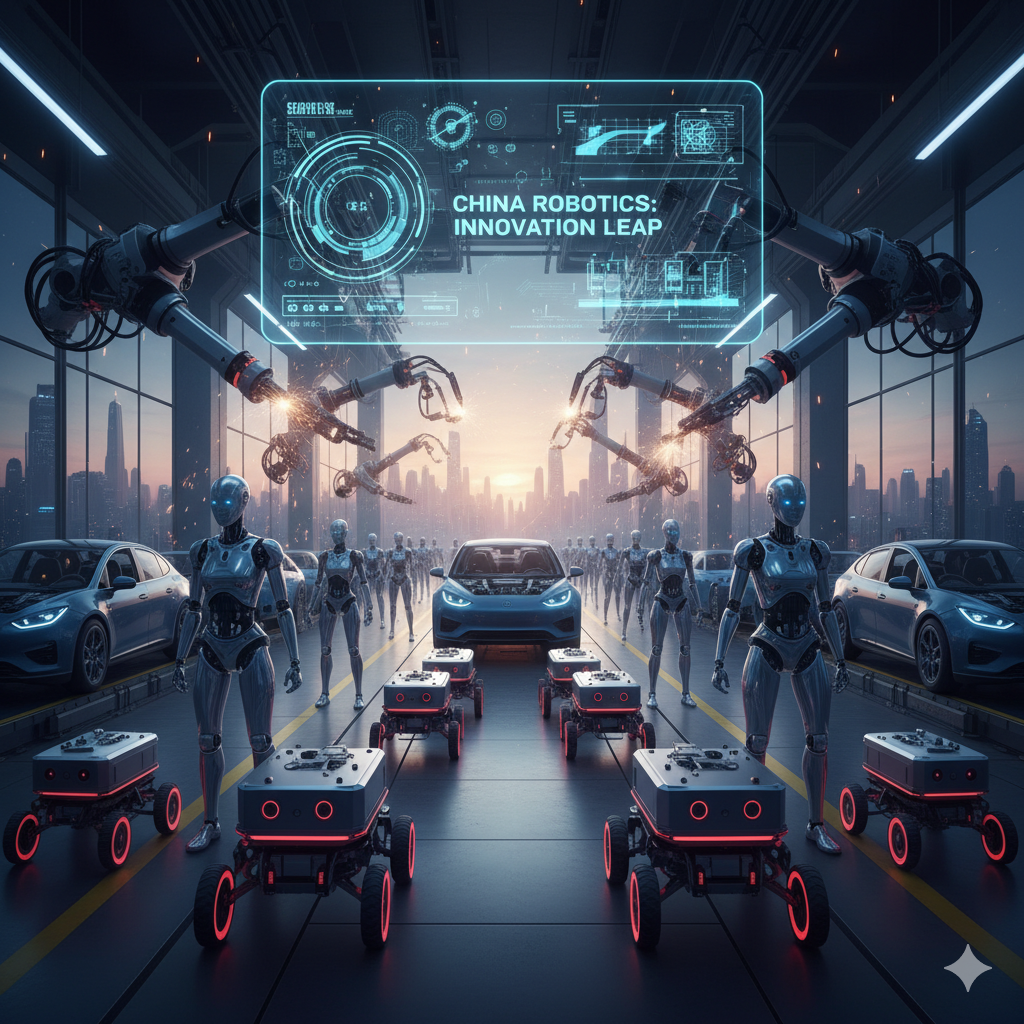
China is moving aggressively to rewire its industrial base through robotics. A growing number of factories are deploying machines that work not just as mechanical arms but as adaptable systems capable of perception and learning. The effort reflects a broader strategy to keep the country’s export edge even as labor pools shrink and trade friction rises.
In one factory outside Shanghai, humanoid robots are being tested in daily routines ranging from folding clothes to opening doors. AgiBot, the startup behind the site, describes it as a real-world laboratory where robots work up to 17 hours a day, generating streams of data to refine performance. During a recent tour, President Xi Jinping visited and quipped that perhaps these machines might one day be able to play football. His presence underscored the symbolic and strategic importance China’s leadership is attaching to the robotics push.
The campaign is about more than hardware. For years, Chinese manufacturers relied on imported controllers and chips to power their machines. Domestic firms could assemble the arms, but the intelligence was sourced abroad. Today, that balance is shifting. Local companies are producing advanced controllers and AI systems, making robots not just stronger but smarter. Analysts describe this as China closing the loop on both the “muscles” and the “brains” of automation.
Global suppliers are responding as well. ABB, one of the world’s major robotics firms, has launched new models tailored for China’s mid-sized manufacturers and is building them in Shanghai. This reflects a recognition that the country is not only the largest robotics market but also one increasingly able to meet its own needs.
By some estimates, Chinese factories install more than a quarter of a million industrial robots annually, nearly half of global deployments. Roughly half of these are now made domestically. The result is a robotics ecosystem that is no longer dominated by foreign firms. A decade ago, overseas suppliers controlled more than 70 percent of the Chinese market; that share has fallen closer to half.
The effects are being felt beyond the giants of auto and electronics. Small and mid-sized manufacturers, long priced out of automation, are beginning to adopt robots as well. Falling costs, easier interfaces, and domestic service networks have made it possible for workshops to install welding or inspection systems that once required far more capital and expertise.
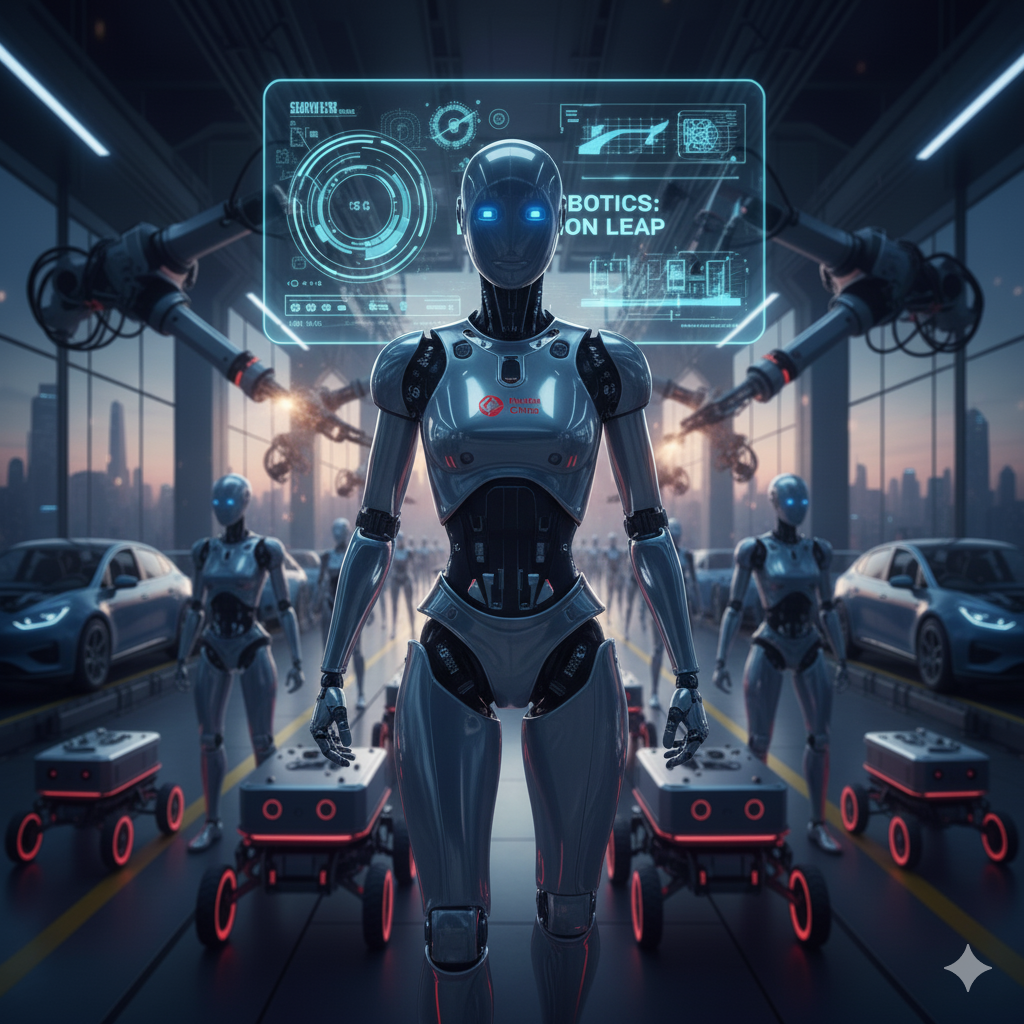
Humanoid models are also making their way into industrial contexts. Unitree Robotics and UBTech have developed prototypes designed to handle complex tasks in crowded spaces, logistics centers, or dynamic factory floors. Some incorporate large language models to follow voice instructions or adapt to new assignments. If these experiments prove reliable and affordable, they could broaden the scope of automation well beyond traditional assembly lines.
The social and technical challenges are significant. Researchers studying the impact of robotics in China note that while machines reduce physical strain on workers, they can also heighten anxiety, especially for older employees or those with fewer skills. Integrating robots into legacy plants remains complex, requiring reconfiguration of spaces and workflows. Flexibility is another issue: human workers are still more efficient in highly customized, small-batch production.
There are broader risks as well. China’s robotics rise could intensify geopolitical competition. Restrictions on chips, software, or foreign investment may become more pronounced as the sector grows in strategic importance. Overinvestment is another concern. Building factories filled with robots that cannot be efficiently deployed could burden balance sheets and erode returns.
Despite the risks, the momentum is clear. Robotics is becoming a central pillar of China’s industrial strategy. It reflects a recognition that low-cost labor can no longer guarantee global competitiveness. The country is betting that automation at scale will provide a new foundation for manufacturing strength.
For the rest of the world, the implications are wide-ranging. Countries that depend on cheap labor for their manufacturing edge may need to invest more heavily in automation to keep pace. The demand for robot technicians and AI integrators is likely to grow, reshaping labor markets. Global supply chains may shift as automation makes production closer to demand centers more practical. And as China strengthens its robotics sector, foreign firms will face tougher competition in what was once a highly protected market.
The outcome is uncertain, but the direction is unmistakable. By pushing robots deeper into its factories, China is laying the groundwork for an industrial future less dependent on demographics or external suppliers. How it manages the human, technical, and geopolitical fallout will help determine whether the effort becomes a durable advantage or another costly bet.

If you liked this post, you’ll love one of the the leading global business communications and technology events since 1999, the ITEXPO #TECHSUPERSHOW, Feb 10-12, 2026 Fort Lauderdale, Florida.
Don’t forget the collocated MSP Expo – just for managed service providers!
Aside from his role as CEO of TMC and chairman of ITEXPO #TECHSUPERSHOW Feb 10-12, 2026, Rich Tehrani is CEO of RT Advisors and a Registered Representative (investment banker) with and offering securities through Four Points Capital Partners LLC (Four Points) (Member FINRA/SIPC). He handles capital/debt raises as well as M&A. RT Advisors is not owned by Four Points.
The above is not an endorsement or recommendation to buy/sell any security or sector mentioned. No companies mentioned above are current or past clients of RT Advisors.
The views and opinions expressed above are those of the participants. While believed to be reliable, the information has not been independently verified for accuracy. Any broad, general statements made herein are provided for context only and should not be construed as exhaustive or universally applicable.
Portions of this article may have been developed with the assistance of artificial intelligence, which may have contributed to ideation, content generation, factual review, or editing