

Key Takeaways:
• Amazon is piloting humanoid robots for last-yard delivery from its electric van fleet
• A dedicated testing site in San Francisco simulates real-world delivery environments
• More than 20,000 Rivian EDVs are already in operation, with plans for 100,000 by 2030
Amazon is exploring the use of humanoid robots to complete the “last few feet” of package delivery — from curbside to customers’ front doors — as part of an expanded automation push for its logistics network. The company is conducting field tests in a specially constructed “humanoid park” in San Francisco, where robots navigate doorsteps, curbs, stairs, and common residential obstacles.
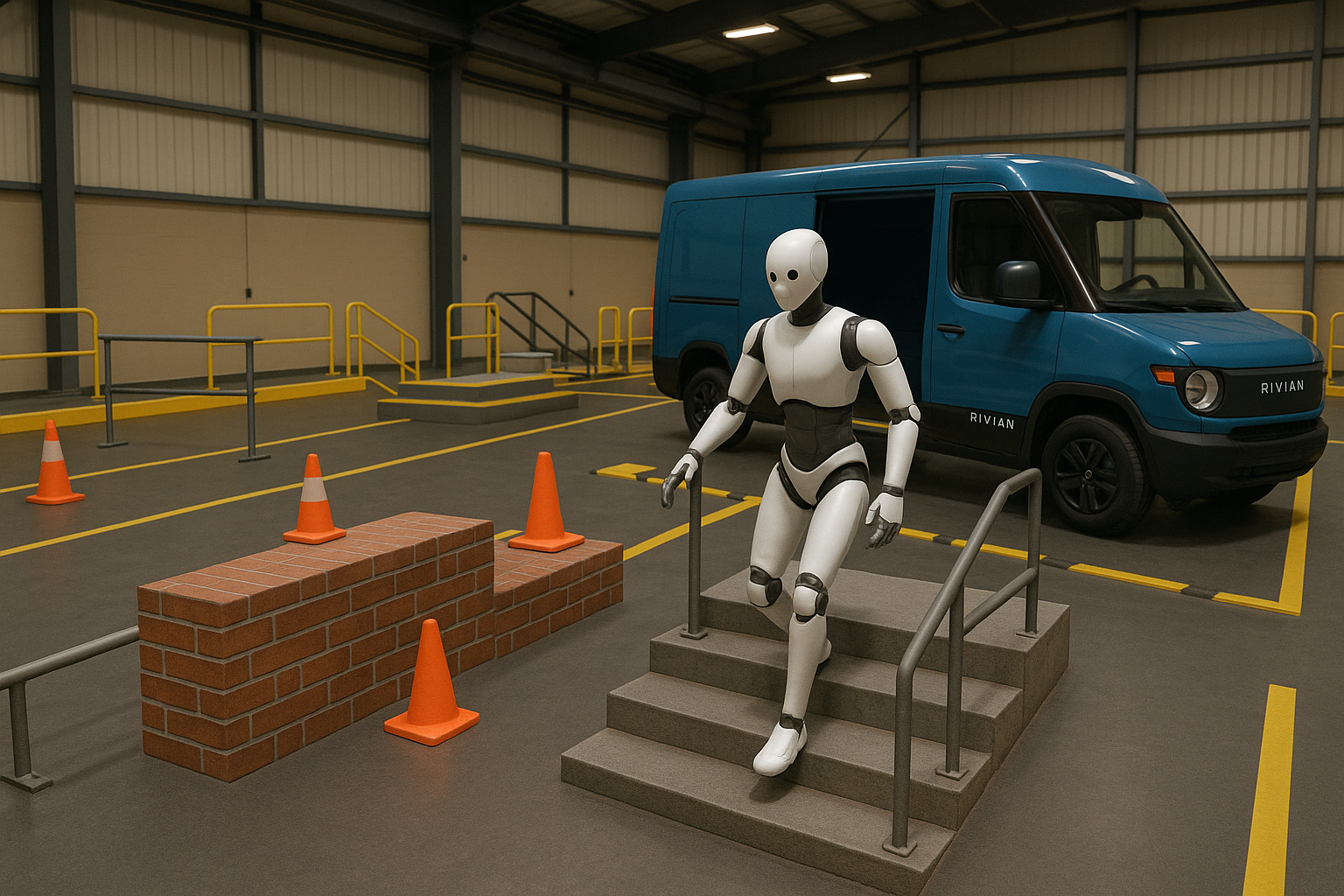
This pilot program is the latest in Amazon’s broader strategy to enhance operational efficiency using advanced robotics. The humanoid robots are being integrated with Amazon’s fleet of Rivian electric delivery vans (EDVs), more than 20,000 of which are already on the road across the U.S. According to company projections, Amazon expects to grow that number to 100,000 EDVs by 2030.
The initiative aims to assess whether humanoid robots can reliably and safely handle a critical but often overlooked segment of the delivery chain — the final steps from vehicle to front door. Unlike drones or ground-based bots that are limited by stairs and narrow pathways, humanoid designs can replicate human mobility, making them a potential solution for diverse delivery environments.
A company spokesperson noted that the San Francisco test site has been designed to “mimic real-world conditions,” allowing robots to be evaluated in scenarios similar to what delivery drivers face daily — from walk-up apartments and gated yards to urban clutter.
Amazon’s move into humanoid logistics comes as other companies are ramping up similar efforts. Startups like Agility Robotics and Apptronik have developed bipedal robots for warehouse or industrial use, and some have already signed contracts with logistics firms and national retailers.
Although Amazon has not disclosed which company or team developed the humanoid robots in its current trial, the move is consistent with its increasing investments in robotics, automation, and AI to streamline logistics, reduce delivery times, and address labor shortages.
Amazon’s broader automation strategy also includes warehouse robotics, AI-enhanced route optimization, and robotic arms used in sorting facilities. Adding humanoid robots to the last-yard delivery phase could serve to bridge automation between Amazon’s high-efficiency back-end systems and the human-centric complexity of individual homes and businesses.
Importantly, the company has indicated this is still a test phase. “These are early days,” the spokesperson said. “We’re learning what works and what doesn’t. Safety, customer experience, and reliability are top priorities.”
Amazon previously piloted sidewalk delivery robots under the Scout program, which was paused in 2022 due to limitations in real-world performance. The shift toward humanoid robots suggests a broader ambition to solve challenges that traditional delivery bots could not.
While full-scale deployment is likely years away — if at all — the real-world testing in San Francisco signals Amazon’s commitment to evaluating whether humanoid robots can become a viable extension of its delivery network. The outcomes of these trials will help determine whether the technology will eventually scale into dense urban areas, suburban neighborhoods, or remain a controlled, experimental component.
Context: Amazon’s Electrification and Robotics Push
The company’s partnership with Rivian has already yielded a growing fleet of electric delivery vans, aligned with Amazon’s broader climate pledge to reach net-zero carbon emissions by 2040. The Rivian EDVs are designed specifically for Amazon, featuring built-in integration with delivery apps, safety systems, and telematics.
Humanoid robot delivery would be the logical extension of an increasingly electric, automated delivery network — one that stretches from the fulfillment center to the customer’s front door with minimal human involvement.
Learn how AI Agents can supercharge your company’s profits and productivity at TMC’s AI Agent Event in Sept 29-30, 2025 in DC.

Rich Tehrani serves as CEO of TMC and chairman of ITEXPO #TECHSUPERSHOW Feb 10-12, 2026 and is CEO of RT Advisors and is a Registered Representative (investment banker) with and offering securities through Four Points Capital Partners LLC (Four Points) (Member FINRA/SIPC). He handles capital/debt raises as well as M&A. RT Advisors is not owned by Four Points.
The above is not an endorsement or recommendation to buy/sell any security or sector mentioned. No companies mentioned above are current or past clients of RT Advisors.
The views and opinions expressed above are those of the participants. While believed to be reliable, the information has not been independently verified for accuracy. Any broad, general statements made herein are provided for context only and should not be construed as exhaustive or universally applicable.
Portions of this article may have been developed with the assistance of artificial intelligence, which may have contributed to ideation, content generation, factual review, or editing.