

Key Takeaways:
• Rice University researchers have developed a light-powered soft robotic arm controlled by AI, capable of complex motion without onboard electronics
• The system uses safe blue laser light and an AI model to bend, flex, and navigate obstacles in real time
• The breakthrough could reshape biomedical devices, soft goods manufacturing, and robotic handling of delicate tasks
In a research breakthrough that blends soft materials, artificial intelligence, and optics, Rice University scientists have developed a robotic arm that moves and adapts in real time—powered entirely by light and guided by AI. The proof-of-concept system operates without wires, motors, or onboard electronics and may open doors to future applications in medicine, manufacturing, and other fields where delicate, programmable motion is required.
The system is based on a soft robotic arm made from azobenzene liquid crystal elastomer—a flexible, light-sensitive material that responds to blue laser beams by bending and relaxing in predictable ways. Using a spatial light modulator, researchers control dozens of “beamlets” of light that direct different parts of the robotic arm to move in coordination, mimicking the adaptability of octopus tentacles or plant stems reaching toward light.
“This was the first demonstration of real-time, reconfigurable, automated control over a light-responsive material for a soft robotic arm,” said Elizabeth Blackert, lead author of the study published in Advanced Intelligent Systems.
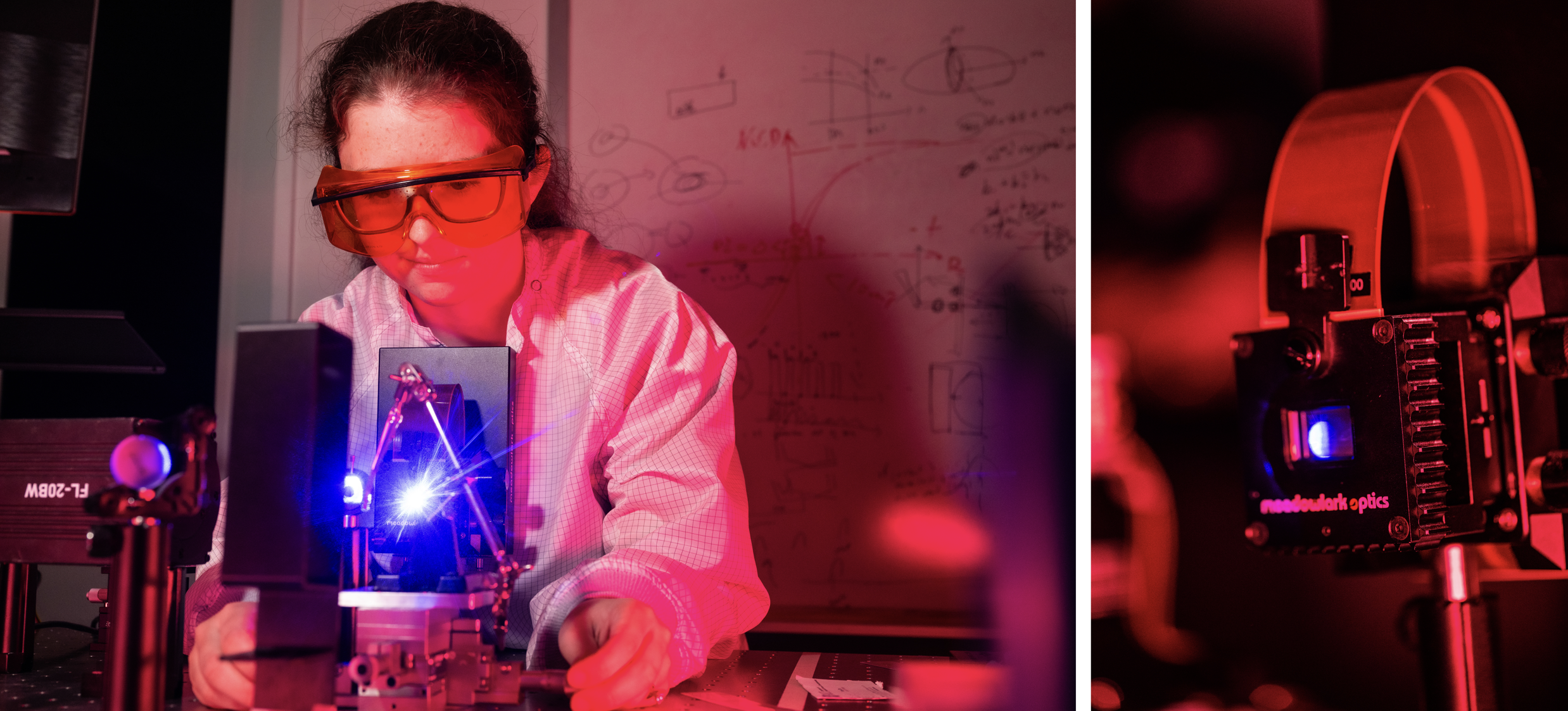
No Motors, No Wires—Just Light and Learning
The heart of the system is a neural network trained to predict which light pattern is required to trigger a specific arm movement. This eliminates the need for traditional electronics or human-operated commands. Once trained, the AI model outputs precise light instructions to produce actions such as reaching, curling, or avoiding obstacles.
While previous soft robotic systems relied on pre-patterned materials or mechanical control, this model enables real-time reconfiguration. The light-sensitive material shrinks toward laser beams and returns to shape when the light is removed. By orchestrating which parts of the arm are exposed and for how long, the researchers enable smooth and complex motion—like hitting a target or moving around barriers.
“This is a step toward having safer, more capable robotics for various applications ranging from implantable biomedical devices to industrial robots that handle soft goods,” said Blackert.
Biomedical and Industrial Implications
Because the robotic material responds to longer-wavelength blue light rather than damaging ultraviolet light, it’s safer and more practical for biomedical and close-proximity human applications. Its fast relaxation time—recovering shape within seconds—makes it viable for responsive, repeatable tasks like guiding catheters, assisting during surgery, or handling fragile materials.
The research was led by materials scientist Hanyu Zhu, assistant professor of materials science and nanoengineering, and included contributions from researchers across engineering, AI, and chemistry disciplines. According to Zhu, building this type of programmable soft robot required “a unique blend of expertise involving materials development, optical system design, and machine learning.”
Next Steps
While the prototype operates in two dimensions, the team is already working toward three-dimensional motion using additional sensors and cameras. Long-term, this approach could yield a new generation of soft robots that are lightweight, untethered, and precisely controllable—opening possibilities for environments where traditional rigid robotics fall short.
Funding for the research came from the National Science Foundation, the Welch Foundation, and JP Morgan Chase’s AI Research Program.
Learn how AI Agents can supercharge your company’s profits and productivity at TMC’s AI Agent Event in Sept 29-30, 2025 in DC.

Rich Tehrani serves as CEO of TMC and chairman of ITEXPO #TECHSUPERSHOW Feb 10-12, 2026 and is CEO of RT Advisors and is a Registered Representative (investment banker) with and offering securities through Four Points Capital Partners LLC (Four Points) (Member FINRA/SIPC). He handles capital/debt raises as well as M&A. RT Advisors is not owned by Four Points.
The above is not an endorsement or recommendation to buy/sell any security or sector mentioned. No companies mentioned above are current or past clients of RT Advisors.
The views and opinions expressed above are those of the participants. While believed to be reliable, the information has not been independently verified for accuracy. Any broad, general statements made herein are provided for context only and should not be construed as exhaustive or universally applicable.
Portions of this article may have been developed with the assistance of artificial intelligence, which may have contributed to ideation, content generation, factual review, or editing.